
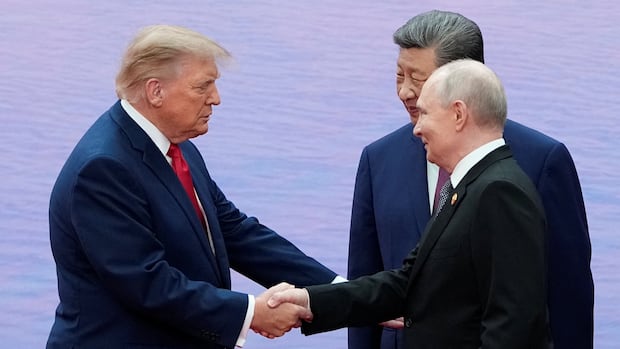

On Wednesday, President Xi Jinping of China committed to opposing trade protectionism, while Russian President Vladimir Putin condemned Western sanctions, as they prepared for a critical trilateral meeting with U.S. President Donald Trump.
Their speeches were delivered at the Asia-Pacific Economic Cooperation (APEC) summit held in Shenzhen, a tech hub in southern China, just hours before Trump’s arrival in China following meetings with important regional allies in Manila.
Xi welcomed Trump at the airport, mirroring the U.S. president’s earlier greeting at Joint Base Andrews during their last encounter in September. The two leaders shared a brief embrace and exchanged pleasantries before proceeding along the red carpet to their respective motorcades.
On Thursday, they plan to meet with Putin on the sidelines, potentially discussing Russia’s ongoing conflict with Ukraine, the U.S. engagement with Iran, and other critical issues such as trade, artificial intelligence, and nuclear arsenals.
Kremlin spokesperson Dmitry Peskov indicated that one hour has been scheduled for discussions among the leaders of Russia, the U.S., and China on Thursday.
A U.S. official, who chose to remain anonymous, along with senior Russian officials cited by Russian media, reported that Trump and Putin would engage in a bilateral meeting. Peskov and the Russian representatives stated that no extensive bilateral talks were organized between the two leaders.
This meeting has drawn parallels to the 1945 Yalta Conference, where the U.S., Britain, and the Soviet Union established spheres of influence, laying the groundwork for the post-World War II order and becoming synonymous with significant power negotiations affecting smaller nations.
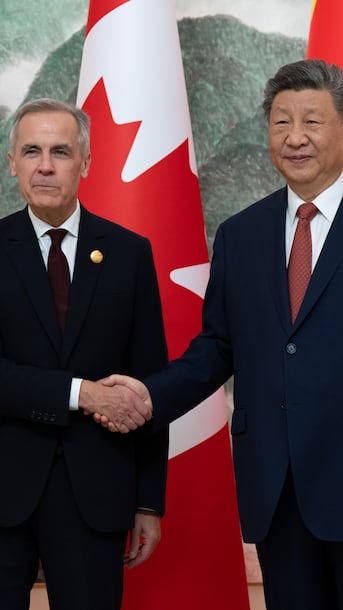
During the APEC summit, Prime Minister Mark Carney and President Xi Jinping announced a reduction in trade barriers between their nations. While some industry representatives expressed satisfaction, other analysts are cautioning against potential national security threats and China’s history regarding rights.
This situation has also caused concern among several European and Asian governments, which fear that the world’s major military powers may overlook their interests.
An editorial in The Wall Street Journal described it as “a sign of Mr. Trump’s unpredictable foreign policy that the [summit] is generating more concern among allies than adversaries.”
This week, the Kremlin dismissed the Yalta Conference comparisons as “political scientists’ games,” yet acknowledged that the upcoming meeting will significantly affect global politics. Beijing asserted that the trilateral discussions would foster world peace.
-
Carney meets with Trump at APEC, says Canada’s trade with China isn’t U.S. president’s top concern
-
Canada and China announce new trade measures and cultural partnerships on Carney’s 1st day in Shenzhen
In his opening remarks, Xi called for support of what he termed “free and open trade,” aiming to present his nation as a reliable partner in the international arena, contrasting it with the U.S., which has imposed tariffs and adopted a more aggressive foreign policy under Trump.
Xi’s statements followed Washington’s announcement of additional restrictions on China’s access to advanced AI chips from firms like Nvidia, which could further complicate an already fragile trade truce with Beijing. China has vowed to respond.
“We must steadfastly uphold the multilateral trading system governed by rules, with the World Trade Organization at its center, promote free and open trade and investment, and ensure the stability and smooth functioning of global industrial and supply chains,” Xi told an assembly of business leaders.
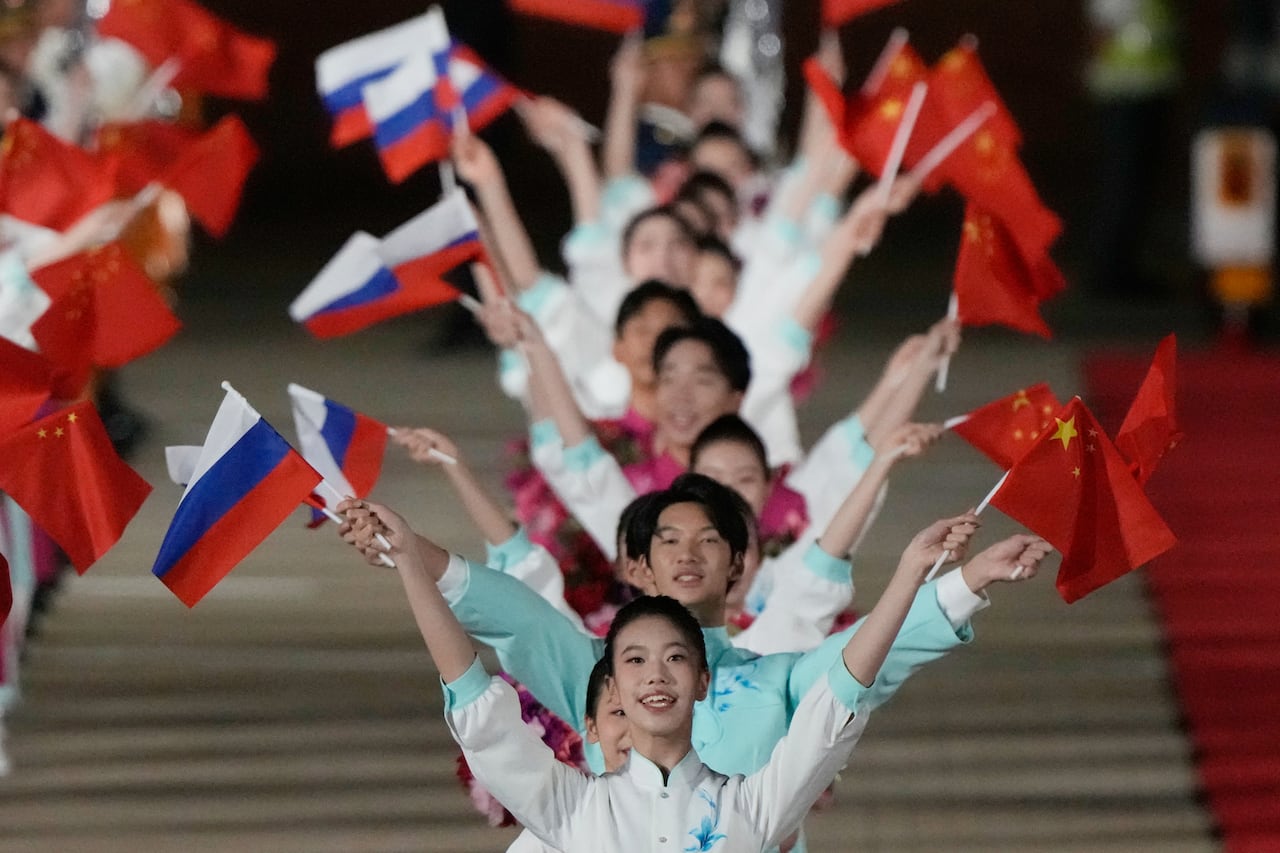
Dancers wave Russian and Chinese flags during the welcoming ceremony for Putin on Wednesday. (Anupam Nath/The Associated Press)
Western trading partners have criticized China for maintaining annual trade surpluses exceeding $1 trillion US due to policies that favor its manufacturing sector at the detriment of consumers.
Beijing argues that its growth model is suitable for an economy still striving to catch up with the wealthiest nations; however, the U.S., the European Union, and others express concerns that China’s supply chain dominance gives the country geopolitical leverage and may adversely affect their industries and employment.
Xi stated that China will persist in investing in its industrial capabilities and developing new technologies that could also benefit other nations. He added that the second-largest economy in the world would reduce tariffs and further open its markets while resisting protectionism and unilateralism.
His message is likely to resonate with numerous countries in the Global South and supports Beijing’s efforts to differentiate its technology strategy from that of Washington, noted George Chen, partner and chair of digital practice at The Asia Group.
-
Analysis
How China is positioning itself as a global leader as it hosts Trump, Putin
-
Ukraine cripples Crimean bridge in blow to Putin before meeting with Xi, Trump
Trump’s journey to Asia marks his first since his Republican Party’s loss in the midterm elections, while allegations involving Nvidia founder Jensen Huang and a suspected Chinese spy escalate tensions.
Trump has downplayed these allegations, having cultivated a strong rapport with Huang over the last two years, and both he and his Commerce Secretary Howard Lutnick have faced inquiries regarding when they became aware of the allegations, especially considering significant decisions made by the White House concerning export controls on Nvidia chips.
-
No plans to reinstate CEO Jensen Huang, Nvidia chair tells investors
-
Analysis
What the Jensen Huang scandal means for Trump and his administration
Most experts anticipate that Washington and Beijing will maintain a relatively stable relationship, as Trump and Xi are scheduled to follow their Shenzhen meeting with a fourth encounter this year at the Group of 20 summit in Miami in December.
Putin, who spoke following Ukraine’s significant strike on the Kerch road bridge linking Crimea to Russia, addressed the audience by labeling Western nations as “former hegemons.”
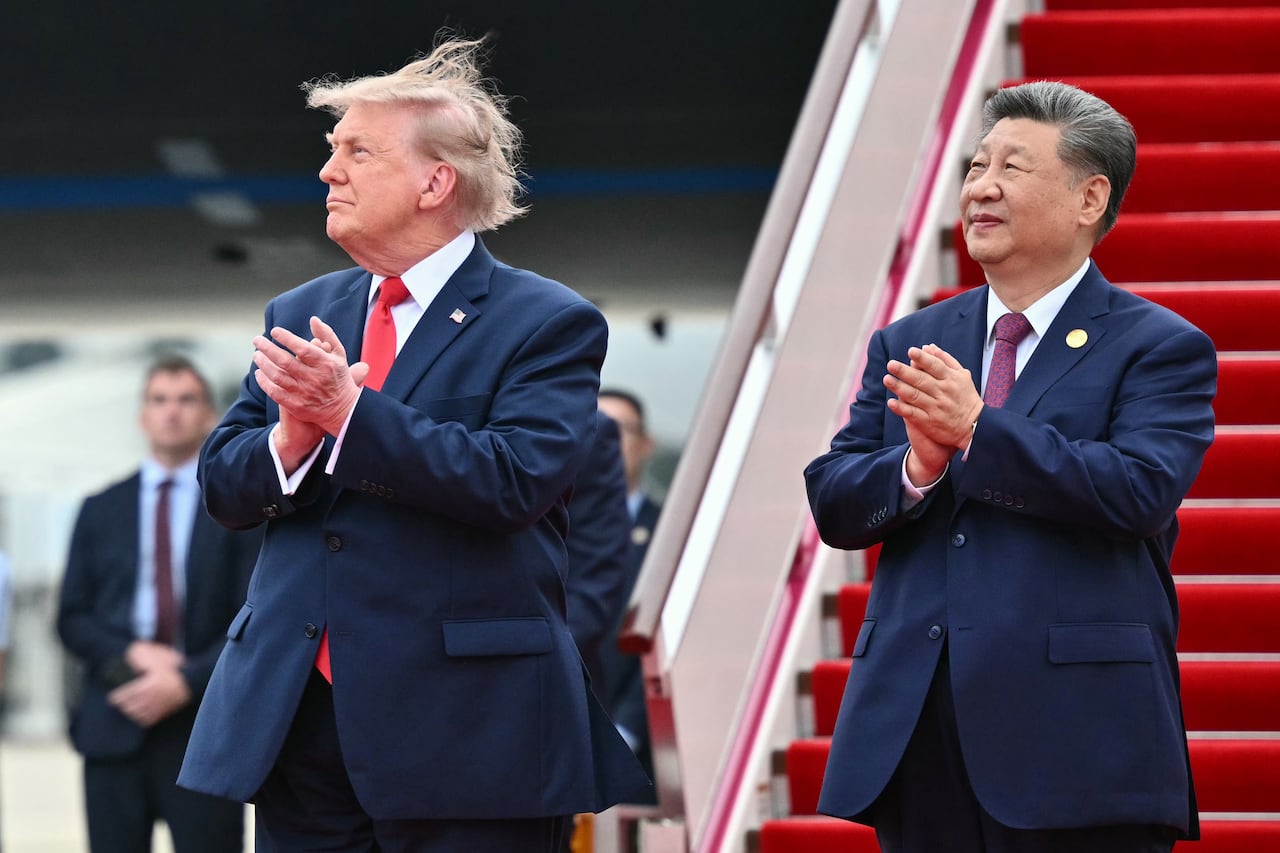
U.S. President Donald Trump and Xi applaud as the U.S. leader arrives at Shenzhen Bao’an International Airport on Wednesday. (Mandel Ngan/Getty Images)
He stated that Europe is experiencing a “humiliating decline” and argued that the anti-Russian sanctions enacted following his invasion of Ukraine have backfired.
“Experience has indicated that traditional methods of economic dominance and coercion have largely lost their effectiveness,” Putin remarked.
“While sanctions, tariffs, and export restrictions may still create some deterrent effect, they are insufficient to halt growth—let alone crush the economies of competitors.”
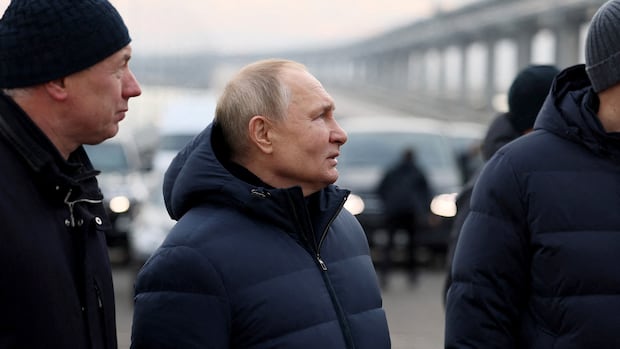
Ukraine’s attack on Russia’s Kerch Bridge in Crimea seems intended to wound Vladimir Putin ahead of his summit with Donald Trump and Xi Jinping, but will it change the course of the war? CBC’s Terence McKenna breaks down how both sides see the bridge, and how Putin might react.
Putin characterized the current global landscape as “turbulent,” but stated that conflicts can be resolved through dialogue.
<p"I therefore anticipate significant opportunities stemming from the forthcoming trilateral meeting," he expressed.
On Tuesday, Taiwan and Japan reported incursions by Russian aircraft into their airspace.
In a subsequent bilateral meeting, Xi and Putin commended their strong partnership and committed to implementing more initiatives that foster a “multipolar world.”
During his stay in Manila, Trump pledged to enhance defense cooperation with the Philippines amid rising tensions with Beijing regarding contested territories in the South China Sea. Earlier, he mentioned the possibility of meeting North Korean leader Kim Jong Un in China, although this has not been confirmed.