

U.S. futures are on the rise as the tech sector aims for a recovery after a significant sell-off of AI stocks last week.
On Monday, S&P 500 futures increased by 2.9 per cent, while Dow Jones Industrial Average futures climbed by 2.1 per cent. Nasdaq futures jumped by 3.6 per cent.
Stocks associated with AI, including Nvidia, Broadcom, and Advanced Micro Devices, experienced the most selling pressure on Friday, yet all three saw significant gains before the market opened on Monday. Nvidia’s stock soared by 8.2 per cent in premarket trading, while Advanced Micro Devices shares increased by 4.3 per cent. Broadcom’s stock rose by 5.5 per cent.
Anthropic, the developer of the Claude AI tool, following a successful IPO on Thursday, saw its shares rise by 4.2 per cent before the market opened.
In recent weeks, shares of AI firms have faced pressure, with some analysts suggesting that the high valuations and substantial expenditures of these companies are not warranted.
CrowdStrike announced its acquisition of Zscaler for $44 billion in an all-stock transaction on Monday, marking a significant consolidation within the cybersecurity industry. CrowdStrike’s shares fell by 7.4 per cent on Monday, while Zscaler’s stock surged by 18.6 per cent.
Dan Ives, a financial analyst at Yorkville Ives & Co., remarked, “This is the most definitive indication that the cybersecurity landscape is consolidating into a few major platforms, driven by the AI era compelling vendors who previously preferred partnerships.”
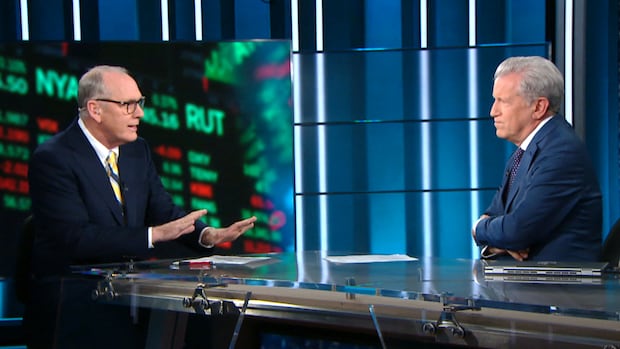
The tech-driven stock sell-off on Friday pushed major markets into correction territory, but what’s truly happening? CBC’s senior business correspondent Peter Armstrong delves into how the Nvidia controversy and rising AI concerns have unsettled investors, and why it might be premature to forecast a wider downturn.
The U.S. stock market will observe a closure on Thursday for Thanksgiving, with a shortened trading session on Friday.
However, several economic indicators are set to draw significant attention this week.
On Tuesday, the U.S. Conference Board will publish its consumer confidence index.
The U.S. Commerce Department will report on consumer spending and inflation for October on Wednesday. The personal consumption expenditures price index, which is the Federal Reserve’s preferred inflation measure, registered at 3.1 per cent in September.
The department will also release its second estimate of U.S. economic growth for the third quarter on Wednesday. The initial estimate indicated a growth rate of 3.4 per cent from July to September, bolstered by robust consumer spending and investment in AI.
This growth surpassed the second quarter’s rate of 2.2 per cent.
Oil prices dip
On Monday, oil prices experienced a decline, as a recovery in supply continued to alleviate concerns despite the ongoing lack of a permanent agreement between the U.S. and Iran regarding the war. Analysts predict that oil and fuel prices may decrease further as global supply stabilizes, potentially alleviating some inflationary pressures.
Brent crude, the global benchmark, fell by 1.9 per cent to $90.83 per barrel, although this remains significantly higher than the approximately $72 per barrel seen in late February prior to the war’s onset. U.S. benchmark crude dropped by 1.7 per cent to $82 per barrel.
In Europe, Britain’s FTSE 100 climbed by 0.6 per cent to 10,411.63. France’s CAC 40 increased by 0.7 per cent to 7,981.21, while Germany’s DAX rose by 0.8 per cent to 25,017.10. Markets in Tokyo were closed due to a holiday, while other Asian markets experienced declines.
The U.S. dollar strengthened to 159.08 Japanese yen from 158.62 yen. The euro decreased to $1.0963 from $1.10973.