
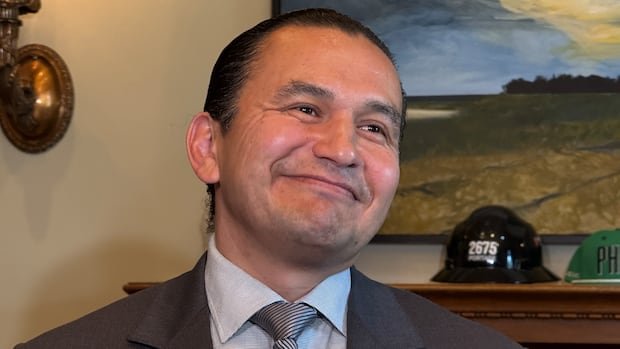

Manitoba’s leader expresses a hesitant willingness to reintroduce American alcoholic beverages as part of a potential trade agreement, with a caveat: “Don’t purchase it.” Canadian and U.S. officials are in discussions to finalize a deal that would prevent new U.S. tariffs on approximately $30 billion worth of Canadian goods. Prime Minister Mark Carney and his team deliberated on the impending deal with cabinet members and provincial leaders.
Kinew mentioned that Carney urged provinces to bring back American alcohol to retail stores, yet Manitoba has not yet consented to this. Even if U.S. products return to Liquor Marts as part of the trade deal, Kinew advised Canadians to opt for Canadian alternatives instead. “Avoid purchasing it. Let it remain on the shelf… and opt for Canadian products instead,” he emphasized during a press briefing at his office on Thursday.
In 2025, the province initially removed millions of dollars’ worth of American-made alcohol in response to Trump’s imposition of tariffs on Canadian goods that did not comply with the Canada-U.S.-Mexico trade agreement.
Manitobans queued up extensively to buy American liquor for a limited period in December, following the province’s decision to reintroduce some stock before Christmas and donate $2.6 million in earnings to charitable organizations. American wines and liqueurs set to expire in the fall were also sold at Liquor Marts in May.
Despite the availability of U.S. alcohol, Manitobans increasingly favored local options, resulting in nearly $21 million in year-over-year sales growth at the province’s Liquor Marts, as reported in June.
Other Prairie provinces reinstated U.S. alcohol on store shelves much earlier. While Alberta removed U.S. alcohol from shelves in March 2025 along with other provinces, it rescinded the ban three months later, citing a renewed commitment to fair trade. Saskatchewan briefly imposed a ban in March 2025 but reversed the decision two months later.
Carney urged the premiers not to exclude the U.S. from their procurement policies, Kinew revealed. Since the onset of the trade war last year, Manitoba’s procurement policies have favored Canadian or non-American sources, leading to an 82% decline in the province’s spending on American companies, Kinew stated.
The Opposition leader in Manitoba criticized Kinew, claiming that the premier’s support for local products was overstated, pointing out a $36-million contract with American-based Aramark food services signed in July 2025. Progressive Conservative Leader Obby Khan stated that Kinew continued to allocate millions to American firms.
Kinew stated that Carney mentioned the necessity of reintroducing U.S. alcohol to shelves for the trade deal to proceed with the Trump administration. While waiting for further details on the deal, including specific tariffs on steel and aluminum, Kinew advocated for zero tariffs. He highlighted the need for support for workers, particularly at facilities like the Gerdau steel mill in Selkirk, for Manitoba to agree to the terms.
Kinew criticized Trump as erratic, irresponsible, and untrustworthy, expressing reservations about the longevity of any deal reached. He emphasized Manitoba’s right to remove U.S. alcohol from shelves again if needed.
In response to Kinew’s remarks, a California winemaker and former Winnipeg resident, Steve Matthiasson, emphasized the need to differentiate between U.S. alcohol producers. He highlighted the challenges faced by California winemakers due to decreased exports following the removal of American products from Canadian shelves.
Public opinion in Winnipeg varied regarding the potential return of American liquor to Liquor Marts, with some supporting Carney’s concession on U.S. alcohol. Many expressed a preference for local products, aligning with Kinew’s advocacy for buying Canadian.