
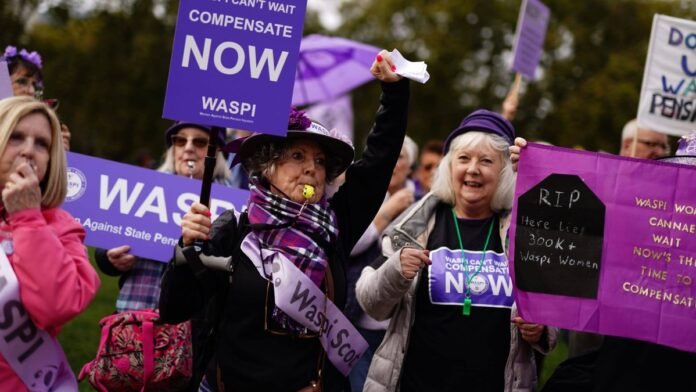

Millions of women affected by the WASPI issue will not be receiving compensation as the Government has made it clear that no payouts will be granted despite a recent review. The Secretary of Work and Pensions, Pat McFadden, addressed the Commons stating that even with new information emerging, approximately 3.6 million women will not be compensated. He argued that the majority of women born in the 1950s were aware of the changes in pension age, making it unjust to burden taxpayers with the cost of compensating them.
This decision is expected to lead to a contentious legal battle between campaigners and the Department of Work and Pensions (DWP). Campaigners have criticized the Government for disregarding the plight of affected women, while Members of Parliament have condemned it as a betrayal.
The most severely impacted women faced financial hardship when the State Pension age was raised without proper communication from the DWP. Despite calls for a compensation scheme, Mr. McFadden highlighted the challenges of verifying individual circumstances for millions of women and the impracticality of implementing a fair compensation system that could cost up to £10.3 billion.
Pressure has mounted on the Government to reconsider its stance on compensating 3.6 million women with amounts ranging from £1,000 to £2,950. The WASPI group was preparing for a legal confrontation in December to demand a judicial review, but legal action has been postponed pending the outcome of the latest review.
In 2024, the Government acknowledged a 28-month delay in notifying affected women about the pension age change but declined to provide financial compensation. This decision came despite recommendations from the Parliamentary and Health Service Ombudsman (PHSO) to establish a compensation scheme immediately.
Angela Madden, chairwoman of WASPI, criticized the Government for its disregard of 1950s-born women, Parliament, and the Parliamentary Ombudsman. She emphasized the need for justice and vowed to explore all avenues in Parliament and the courts to rectify the injustice suffered by millions of women.
Research from 2007 regarding the effectiveness of sending letters surfaced late last year, prompting a review by Mr. McFadden before a final decision is made. He acknowledged the delay in sending letters and extended an apology on behalf of the Government, emphasizing the impact of the delay on affected women.
The decision has sparked outrage among opposition parties, with Labour backbencher Barry Gardiner expressing concerns over the injustice faced by these women. The Liberal Democrats’ work and pensions spokesman, Steve Darling, described the decision as a blow to over 3.6 million women and highlighted the sense of betrayal felt by those who were given false hope.
Campaigners have raised over £250,000 to support their legal challenge against the DWP for its failure to communicate the changes in the state pension age effectively. The affected women, whose pension age was raised from 60 to 65 and then 66, were left struggling to plan for their future, leading to financial hardships and uncertainty in retirement.