
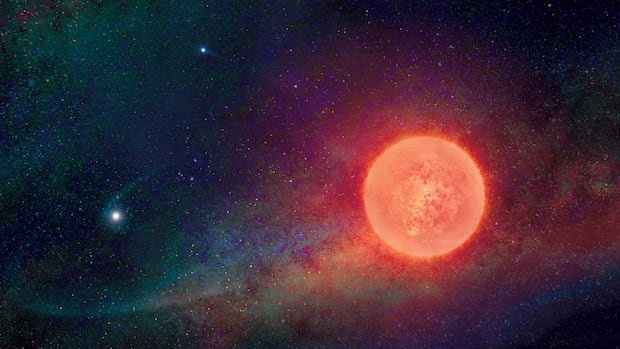

Approximately 28 light-years away from our planet exists an unusual star system known as IRAS 21500+5903.
For many years, scientists were aware of the two stars that circled around each other. However, while searching for exoplanets — planets that revolve around stars other than our sun — a team of astronomers stumbled upon an unexpected find: an additional star in the system. Rather than being a binary system, it turned out to be a triple-star system.
“It’s an odd phenomenon. It was a frustrating object,” stated Étienne Artigau, a researcher at the Trottier Institute for Research on Exoplanets (IREx) affiliated with the University of Montreal. “It wasn’t what we were aiming to find.”
Their results were published this week in the journal Astronomy & Astrophysics.
This system features a red dwarf, a very common type of star in our galaxy, along with two smaller, dense white dwarfs. One white dwarf is situated roughly 1,000 astronomical units (the distance from the sun to Earth) from the red dwarf, while the other is only two astronomical units away, comparable to the distance from the sun to Mars.
The inner white dwarf orbits the red dwarf, whereas the outer white dwarf orbits both.
An unusual neighbor
What’s astonishing is that it had gone unnoticed for decades.
“It’s strange that no one has identified the system, but it also indicates that there are odd phenomena overlooked right next to us,” Artigau remarked. “It’s not directly next door, but just down the road, merely a block away in our stellar neighborhood.”
When a low- to medium-mass star reaches the end of its lifecycle, it first expands into a red giant before leaving behind a dense, small white dwarf. This is what will eventually occur with our own sun in about five billion years.
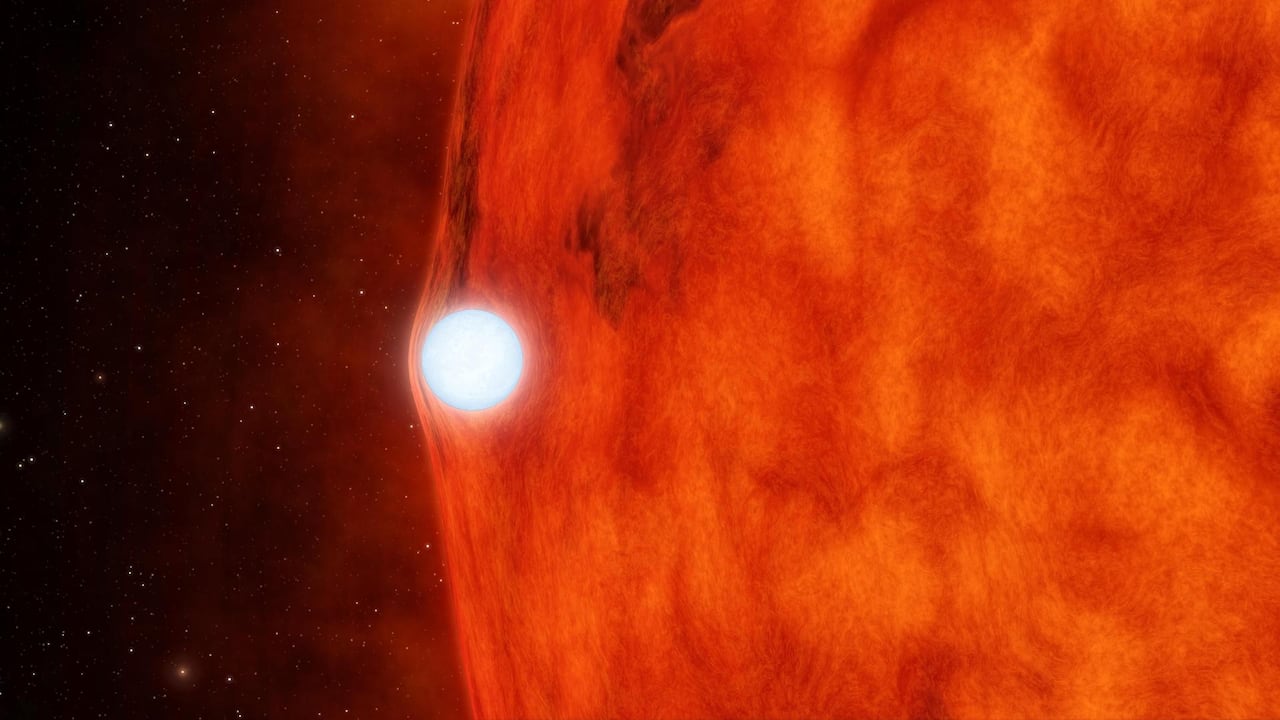
This artist’s concept illustrates an ultra-dense dead star, known as a white dwarf, transiting in front of a small red star. (NASA/JPL-Caltech)
During the exploration for an exoplanet within this system, the international astronomer team — led by the University of Montreal — employed an instrument at the Canada-France-Hawaii Telescope in Maunakea, Hawaii, named SPectropolarimètre InfraROUge (SPIRou). This device is used to identify exoplanets by detecting minor variations in a star’s velocity, which can be influenced by orbiting planets.
However, the red dwarf was exhibiting unexpected behavior, showing velocity variations of nearly 16 kilometers per second, which is a significant difference.
At first, they speculated it might be a brown dwarf, a type of substellar object with a mass approximately 75 times that of Jupiter.
But that hypothesis still didn’t add up.
Further oddities
The velocity discrepancies were so pronounced that they disrupted Artigau’s calculations.
“At one point, we concluded that something was amiss with that object. So, I corrected the code,” he explained. “Then we thought, let’s calculate the details of that brown dwarf. Okay, no, that doesn’t fit.”
It was quite a puzzling conundrum.
-
Are we alone? Institute searching for alien signals is using a new way to answer that age-old question
-
Astronomers think they’ve captured a planet forming around a host star — something never seen before
Ultimately, they found that the disturbances were caused by a high-mass… object. However, it was also invisible.
Could it be a black hole? A neutron star? A white dwarf?
The team then utilized the Gemini North telescope, also located on Maunakea. By employing high-resolution images from its ‘Alopeke instrument — a specialized high-speed camera — they succeeded in identifying what they sought: a faint companion star — a white dwarf — closely orbiting the red dwarf.
This is where it becomes even stranger.
Prior to transforming into a white dwarf, the star would have expanded into a red giant. As it grew, its orbit would have been so close to the red dwarf that interactions between the two would have been likely. Often, such stars engulf the red dwarf, or the two may fuse. Yet, that did not occur.
Additionally, the inner white dwarf should be spiraling inward toward the red dwarf, but it remains in a stable orbit instead.
It’s possible that the more distant white dwarf is somehow maintaining this stability, although the specifics remain unclear. This will be the focus of future investigations.
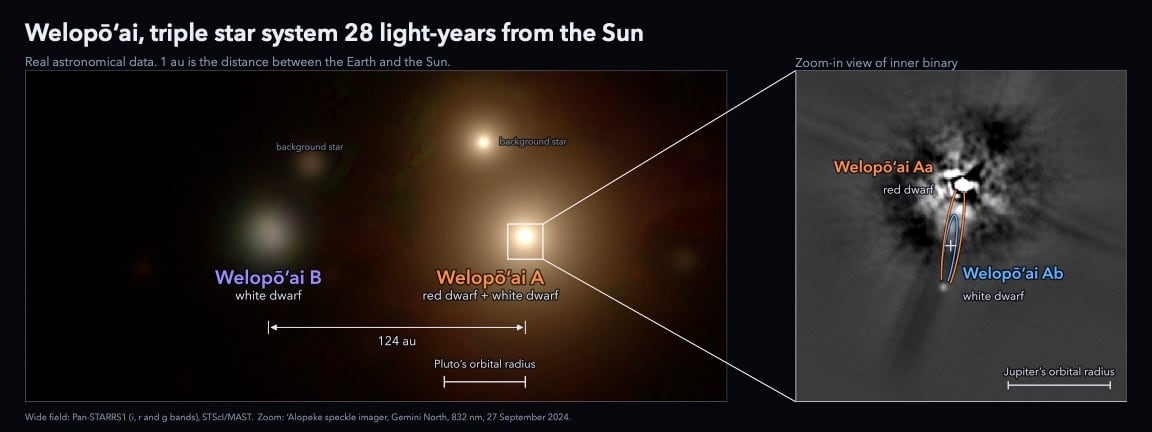
The left image depicts the two components of the system: Welopō’ai A, a closely orbiting red dwarf and white dwarf pair, and Welopō’ai B, a second white dwarf located farther away. The right image provides a close-up view of the inner pair and their orbital paths. (Pan-STARRS1/STScI/MAST, left, International Gemini Observatory/NSF NOIRLab, right. Graphical construction by Étienne Artigau & Heidi White (UdeM/IREx))
“We’re suggesting it shouldn’t exist,” Artigau stated. “Yet, it undeniably does. It’s there.”
Paul Delaney, professor emeritus of physics and astronomy at York University in Toronto, proposes that the more distant white dwarf may have originally been much closer to the other two stars.
“When planetary systems form nowadays, migration is often a standard occurrence,” he explained. “I would wager that they were relatively close to each other and then engaged in some gravitational interactions, resulting in the more distant white dwarf being much closer in the past.”
To complicate matters further, astronomers estimated the age of this system to be around 10 billion years, making it older than our solar system, which is approximately 4.6 billion years old, and its stars are rich in metals. Typically, older stars are known to be metal-poor.
“It’s intriguing, and we still don’t know if it has any significant meaning. It could simply be a random occurrence within a stellar population,” Artigau remarked.
Continuing the search for exoplanets
The astronomers designated this system with the Hawaiian name Welopō’ai, combining “welo,” meaning an inherited family trait, and “pō’ai,” which signifies an orbit or circular path. Thus, the name translates to “path of family traits.”
The well-known book and Netflix series 3 Body Problem explores a triple-star system and the potential effects it could have on a nearby planet, particularly regarding a civilization that has developed there.
One of the terms used in the show to describe the triple-star system is “chaotic,” which impacts the rate at which civilization can evolve.
This presents an age-old dilemma in physics. Two-body systems are predictable, but introducing a third body complicates everything. This is due to the gravitational influences each body has on the others, leading to perpetual changes in their motions and forces.
Although researchers did not discover any exoplanets, Artigau emphasized that the quest is ongoing.
“This system is so unique that Atanas Stefanov, one of the contributors, is applying for time to search for planets around the red dwarf,” he noted.
Whether a planet exists there or if an alien civilization could thrive in a triple-star system remains to be determined.
For Artigau, the emergence of new findings is particularly thrilling.
“I enjoy it,” he expressed. “Unexpected developments in research are exciting. It’s fun.”
Tag: rewrite-pending