
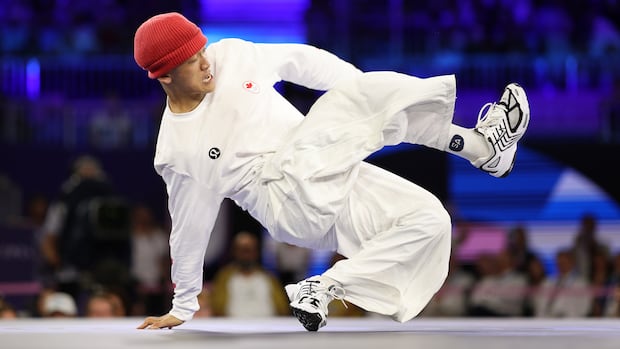

During his high school years, Philip Kim often snuck into a computer lab to catch the Red Bull BC One World Final.
This Sunday, the Canadian B-boy, known as Phil Wizard, who secured a gold medal at the 2024 Paris Games, will take part in the inaugural edition of this event in Canada, held at the Mattamy Athletic Centre in Toronto.
It marks Kim’s return to the BC One World Final for the first time since 2023. He remarked that this competition was the closest equivalent to the Olympics for breakers prior to the sport’s introduction in Paris.
“I’m incredibly excited to be back,” said the Vancouver resident. “When I learned it was coming to Canada, it felt like a truly special moment. I never imagined this would happen; it was an event I grew up watching.”
“I’ve been lucky enough to compete many times, and to me, it’s the one title I have yet to achieve.”
In contrast to the Olympic event in Paris, which began with a round-robin involving 16 breakers, this Sunday’s world final will feature only eight breakers, with three qualifying through Friday’s Last Chance Cypher.
At 29, Kim shared that a relentless schedule of showcases, performances, speaking engagements, and media interactions prevented him from participating in BC One since the Olympics. He mentioned that he finally had a break this past summer.
“There’s been a significant amount of media focus, especially here in Canada,” he stated.
“I still get recognized on the streets, though not to the extent I did right after my victory.”
Prior to Paris, Kim noted that he was primarily recognized within the breaking community. With his gold medal, he became a prominent figure in a sport that many Canadians were just discovering.
“I remember walking around Toronto the week after my win, and literally every block I passed, people recognized me,” he recalled. “They were like, ‘Yo, you’re Phil Wizard!’”
Breaking will not be included in the 2028 Los Angeles Olympics, a decision made before the sport’s debut at the 2024 Paris Games. Kim acknowledged that some might see this decision as unjust, but he has resolved to “move on and live with it.”
He described his experience competing in Paris as stressful, although he felt the positives outweighed the challenges.
Kim referred to the controversy surrounding the Olympic performance of former Australian breaking champion Rachael Gunn, known as Raygun, as an “unfortunate perfect storm” for the discipline.
Gunn struggled in Paris, losing all three battles without receiving a single judge’s vote. Her kangaroo hop was widely ridiculed online, and this backlash was featured in the Netflix documentary “Untold Raygun: Breaking Badly.”
According to Kim, the women’s competition showcased “the highest level of breaking we have seen in a very long time,” yet the focus on Gunn overshadowed the other competitors.
“I don’t think she’s entirely to blame,” Kim remarked. He expressed concern about how the Olympic qualification process was structured and suggested that Gunn “maintained the spotlight on herself” instead of shifting it to other dancers, which he felt she should have done.
“Even now, people still comment on Instagram posts of mine and other dancers asking, ‘Where was this person at the Olympics?’ when I literally won. They just didn’t watch the event because (Gunn) was the only one they noticed.”
This Sunday, the spotlight will be on breaking itself. Kim has finished as a runner-up twice in the competition he once snuck into a computer classroom to observe.
“BC One has eluded me,” he lamented.