
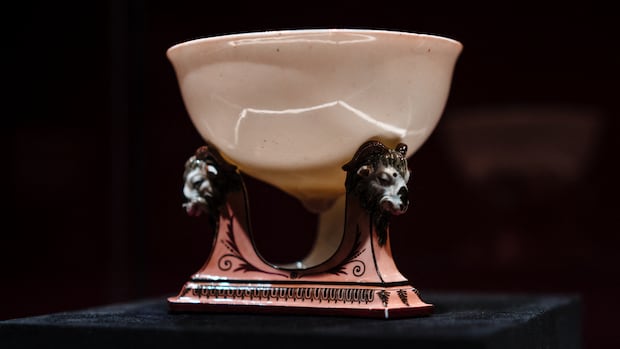

An exquisite porcelain “breast bowl,” commissioned by Louis XVI of France for Marie-Antoinette in the 18th century, fetched approximately $4.5 million at an auction in Paris on Thursday.
This uniquely designed drinking vessel, referred to as a jatte-téton, resembles the form of a woman’s breast, complete with a soft pink nipple, and is supported by a tripod adorned with intricate foliage and three goat heads.
The bowl sold for 2.925 million euros at the French auction house Coutau-Bégarie, setting a new record for a Sèvres piece at auction. Sèvres is renowned as the porcelain maker favored by European royalty during the late 18th and early 19th centuries.
Once thought to be lost, this bowl was discovered unexpectedly in a crate at the Galerie Meyer in Paris, as announced by the auction venue l’Hôtel Drouot in a social media update celebrating the record-breaking sale.
Auction organizers had predicted the bowl would attract bids between one and two million euros (approximately $1.5 million to $3.1 million).
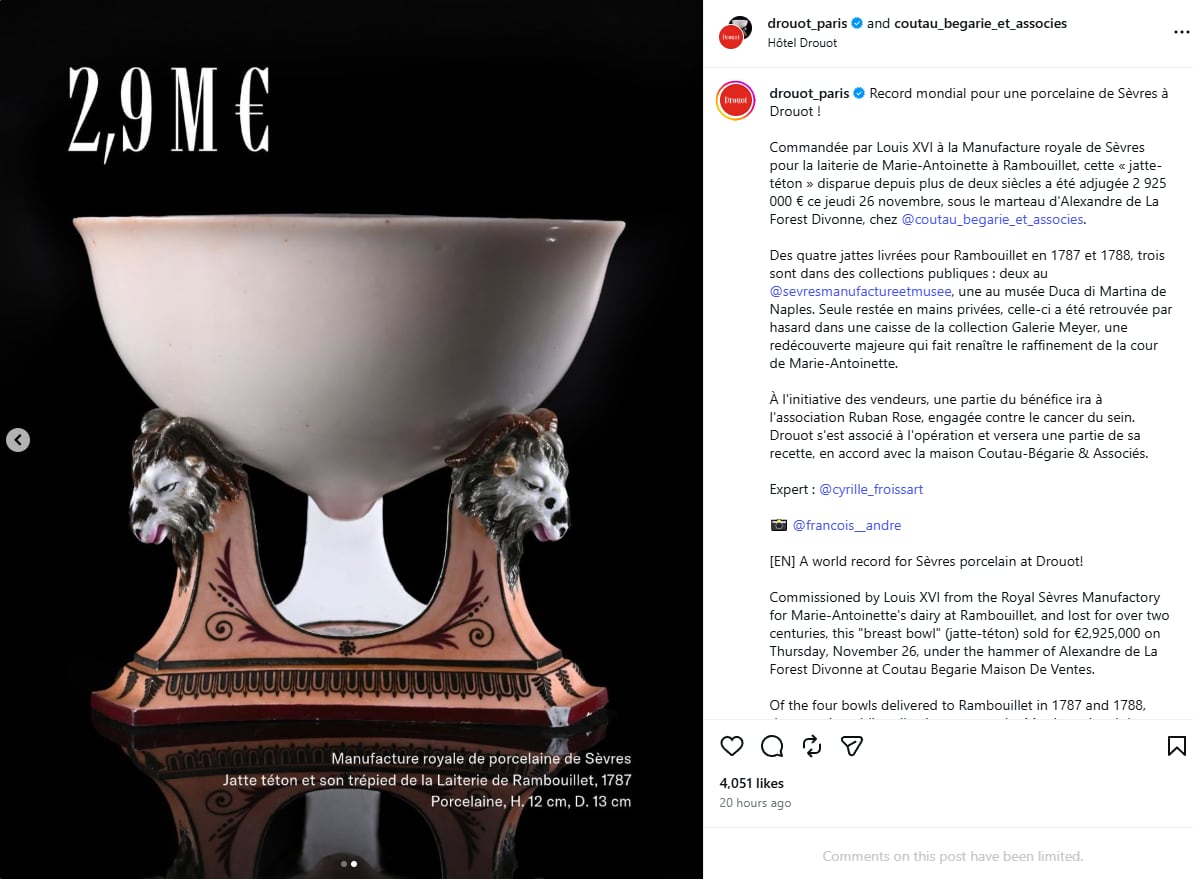
The French auction house l’Hôtel Drouot promoted the sale’s record price online. Three additional bowls from the original set are now part of public collections. (Hôtel Drouot/Instagram)
The identity of the purchaser has not been revealed.
A portion of the proceeds from Thursday’s auction will contribute to breast cancer research, with the seller, the auctioneer, and the venue committing to donate parts of the revenue to the French non-profit l’Association Ruban Rose.
Designed for a ‘pleasure dairy’
Marie-Antoinette was not particularly fond of the Rambouillet estate, located southwest of Paris, which Louis acquired. To win her affection, the king constructed an opulent “pleasure dairy” on the estate, where she could host nobles and indulge in delicacies such as fresh milk, cheeses, and ice cream.
As a luxurious gift, he commissioned artisans from Sèvres to craft an exquisite set of porcelain serving pieces, which included a set of four jatte-téton, inspired by mastos, the Greek breast-shaped drinking cups used at feasts.
Although there is an urban legend suggesting that the shape was modeled after Marie-Antoinette’s own breast, experts from Sèvres have dismissed this claim.
The other three Rambouillet breast bowls are housed in the collections of France’s National Ceramics Museum in Sèvres and the Duca di Martina Museum in Naples.