
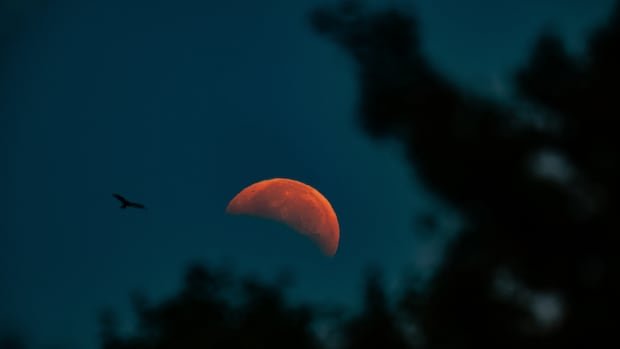

Skywatchers had the opportunity to witness a partial lunar eclipse across the continents of the Americas, Europe, and Africa from Thursday evening into Friday. The eclipse, known as the “almost blood moon,” reached its peak just after midnight ET, with Earth’s shadow covering 96 per cent of the moon’s visible surface, resulting in a near-total lunar eclipse. This rare celestial event is not expected to recur until New Year’s Eve in 2028.
In Canada, observers in Vancouver captured the full moon during a phase of the lunar eclipse in the night sky. Similarly, in Osborne Village, Winnipeg, a stunning image of the partial lunar eclipse was seen above the skyline. Toronto also witnessed the spectacle of the lunar eclipse from the R.C. Harris Water Treatment Plant.
In other regions of the Americas, a person at the George Observatory in Brazos Bend State Park, Texas, took a cellphone photo of the lunar eclipse. In Washington, D.C., the partial lunar eclipse was observed behind the Washington Monument, while in New Orleans, it appeared along the golden edge of the Caesars Superdome. In Ciudad Juarez, Mexico, the moon was visible above the Mexican flag during the eclipse. Meanwhile, in Salvador, Bahia state, Brazil, the moon rose behind a coconut palm during the partial lunar eclipse.
In Europe, the moon’s striking appearance during the partial lunar eclipse was captured over Warsaw. Additionally, people gathered at Parliament Hill in Hampstead Heath, London, to witness the celestial event. In Lisbon, a plane was seen approaching for landing during the eclipse, and in Goutz, France, the reddish hue of the partial lunar eclipse illuminated the night sky.