
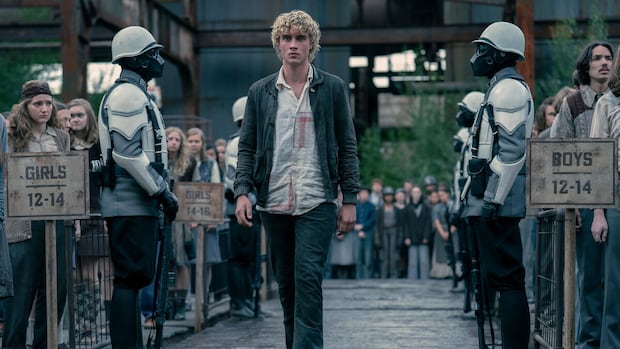

Starting with the latest addition to the The Hunger Games series, Sunrise on the Reaping, might not be the best choice for newcomers.
At first glance, this statement may seem absurd. The franchise already boasts five films in the young-adult, Battle Royale-inspired series, four of which detail the journey of “girl on fire” Katniss Everdeen as she strives to thwart the oppressive Capitol government from forcing randomly chosen youths into brutal combat. One would assume that audiences are familiar with the storyline by now.
So, with Sunrise on the Reaping simply delving into the backstory of a seasoned character who once faced his own harrowing tournament, why does The Hunger Games feel the need to provide such extensive guidance?
The answer lies in the vision of its creator. Director Francis Lawrence has indicated that the intention is to make Reaping accessible for both new viewers and longtime fans, regardless of their familiarity with the previous films — aiming to create a compelling and entertaining mid-tier action movie featuring new characters while allowing it to stand independently.
This is an ambitious dual objective — the first of which Reaping achieves reasonably well as a notable entry in the crowded and often clichéd young-adult post-apocalyptic genre.
However, when tackling the second goal, it either falters significantly or merely scrapes by, resulting in one of the more strangely bleak narratives in the “chosen one” archetype.
Instead of focusing on the indomitable and perpetually thwarted Katniss, the film centers on the battle-worn side character Haymitch Abernathy, whose primary role has been to express dissatisfaction, revealing what caused his intriguing but tragic demeanor when he was first introduced.
This may appeal to long-time followers eager for more context.
However, for those lacking insight into the eventual outcomes of these characters decades later, Reaping presents a different experience. Its portrayal as a painful, almost universally bleak backstory for a single character renders it a peculiarly unsettling film when considered as a standalone piece.
In the earlier Hunger Games film, Haymitch was portrayed by Woody Harrelson as a grizzled, haunted veteran of the games, while Joseph Zada takes on the role here. The events unfold 24 years before the original movie, just prior to the Second Quarter Quell.
This term, somewhat obscure, refers to a significant Hunger Games event that fans know resulted in even greater violence and sorrow than usual, which left an older, angrier Haymitch watching in fury as the deceitful government showcased manipulated, propagandistic footage in the first film.
For those unfamiliar with the context, this film could still conclude with either a heroic success or a noble sacrifice.
Such expectations appear likely as we navigate the standard setup: music video-style scenes of Haymitch reassuring his girlfriend Lenore (Whitney Peak) with a slight southern drawl that he will never abandon her; Haymitch heroically volunteering as “tribute” for his district — the most pitiable and underprivileged district in all of Panem; and his ironic slow-clapping directed at the aloof President Snow (Ralph Fiennes), who looks down at the suffering and dying young fighters in the arena below.

Ralph Fiennes as President Snow in a still from The Hunger Games: Sunrise on the Reaping. (Lionsgate)
These moments serve as expected and effectively executed narrative and moral indicators for the tragic or victorious formula to play out. The narrative gains momentum as the plot progresses, with the enigmatic Beetee Latier (Kelvin Harrison Jr.) emerging from the shadows of the arena compound to offer Haymitch a strategy to dismantle the Capitol from within, opting to abandon the pursuit of victory and aiming to halt the ruling elite’s exploitation.
The only issue is: if Haymitch proceeds with this plan, he likely won’t survive.
Naturally, considering this serves as the backstory for a character who appears alive in other Hunger Games films, this outcome seems improbable. Yet, instead of detracting from the experience for those aware of the overall narrative resolution, it merely diminishes it: what was once an intriguingly mysterious and hinted-at trauma in Haymitch’s past becomes a prolonged sequence of anguish, montage-driven alcoholism, and an abundance of tiny coffins, reminiscent of a Dracula-themed dollhouse.
While the sorrowful collage of trauma in the latter half of Reaping may solidify old fans’ understanding of Haymitch, it presents a bizarre experience for newcomers. Rather than delivering a tale of triumph over authoritarianism — whether genuine, performative, or bittersweet — we encounter a harsh twist that lacks both a coherent emotional foundation and a clear message.
-
REVIEW
Club Kid is one of TIFF’s best. It might make you cry
-
REVIEW
Ebenezer review: Merry Christmas, Johnny Depp! Is this your comeback yet?
A vague theme of learned helplessness is present — the concept of the masses’ implicit submission to a minority, as explained by philosopher David Hume, which The Hunger Games author Suzanne Collins has mentioned. Indeed, the characters in Reaping fail to recognize their potential for resistance.
However, aside from a clichéd, hastily tacked-on conclusion — whose emotional impact relies solely on the assumption that viewers are aware of Katniss Everdeen’s future victories — the remainder feels like mere suffering for its own sake.
The drawn-out, sorrowful depiction of the futility of Haymitch’s life serves to clarify his later resentment — a helpful detail for those who eventually watch the first film. But apart from the uniqueness of a narrative that denies redemption or satisfaction, there is little to offer newcomers to this saga.
With the true conclusion of Sunrise on the Reaping being The Hunger Games, it might be better to begin there, or perhaps not begin at all.