
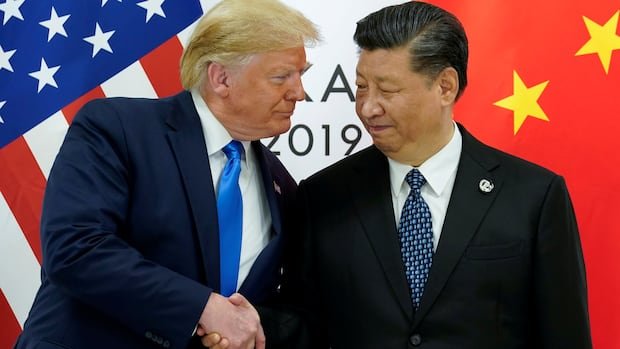

U.S. President Donald Trump warmly welcomed Chinese President Xi Jinping this week, praising him as a “great leader” and aiming to expand or renew a trade deal between both countries that was agreed upon last year to halt certain tariffs and establish a trade ceasefire.
Trump has previously touted his success in negotiating “fantastic trade deals” with China, even expressing openness to Chinese automakers establishing factories in the U.S. during an interview on the Fox News show, The Ingraham Angle. It was reported that Trump secured an extension of the deal with China on Wednesday.
Despite this, Trump and his administration have criticized Prime Minister Mark Carney for a much smaller trade agreement reached in January. The agreement allowed 49,000 Chinese electric vehicles to enter Canada with a reduced tariff rate of 6.1% (down from 100%), while China reciprocated by lowering tariffs on Canadian goods such as canola, peas, lobsters, and crabs.
Transportation Secretary Sean Duffy expressed doubts about the EV deal, suggesting that Canada may regret it in the future. Commerce Secretary Howard Lutnick took a more aggressive stance, accusing Canada of turning its back on the U.S. and questioning Carney’s decision to prioritize China over the U.S.
Jia Wang, a senior fellow at the China Institute at the University of Alberta, pointed out the hypocrisy in the U.S. demanding certain trade practices from its partners while engaging in contradictory actions itself.
In 2025, Canada’s trade with China saw an increase as businesses sought to diversify due to U.S. tariffs, while American importers reduced their purchases of Chinese goods. However, Canada would need to boost its trade with China by over 380% to match the imports the U.S. still receives annually from China.
Sen. Rick Scott, a Florida Republican and ally of Trump, cautioned against Canada increasing trade with China in an essay, emphasizing the risks involved in choosing China over the U.S.
The complexities of trade dynamics were highlighted as various states, including Florida, rely heavily on imports from China. Wang criticized Trump for his zero-sum approach to trade, emphasizing power dynamics over nuanced relationships.
Mark Manger, a professor at the Munk School of Global Affairs & Public Policy, echoed Wang’s sentiments, highlighting the hypocrisy in the U.S. policy of engaging with China while discouraging allies like Canada from doing the same.
Manger emphasized China’s growing influence in global trade and technology, noting that China’s long-term strategy contrasts with Trump’s approach. Both Manger and Wang stressed the importance for Canada to carefully navigate its relations with both the U.S. and China, requiring astute leadership and strategic decisions.
Overall, the evolving trade landscape underscores the need for Canada to balance its engagements with the two largest economies in the world while considering long-term implications.
[Image Description: Prime Minister Mark Carney meets Xi at the Great Hall of the People in Beijing, on Jan. 16.]