
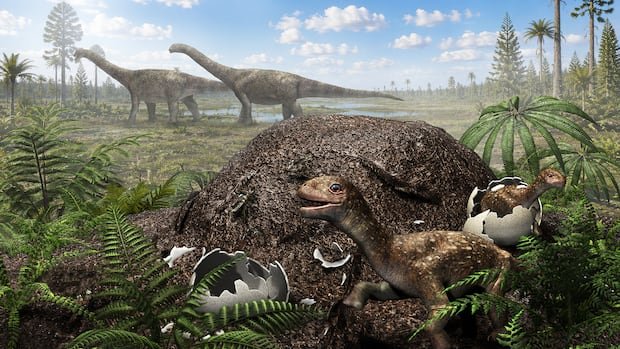

Fossilized eggshells believed to belong to some of the largest dinosaurs ever discovered have been unearthed in a surprisingly cool region far from the equator. Despite their immense size, the colossal titanosaurs could not warm their volleyball-sized eggs by incubating them physically.
A recent study led by University of Calgary paleontologist Darla Zelenitsky, in collaboration with researchers from Japan and Argentina, has delved into the microscopic details to uncover how these titanosaurs ensured their eggs stayed warm enough for hatching without direct nesting. By examining the tiny pores on the eggshells, the team proposes that titanosaurs employed a similar incubation method as modern crocodiles – burying their eggs in warm piles of decaying vegetation.
Titanosaurs, massive plant-eating dinosaurs with long necks and tails, weighing up to 75 tonnes, were known to roam the Earth on four legs. These colossal creatures, roughly half the size of a blue whale, have been linked to volleyball-sized fossilized eggs called Fusioolithus, previously found abundantly in warmer climates. However, in a surprising discovery, fragments of Fusioolithus eggshells were discovered in the Chorrillo Formation at the southern tip of Argentina, dating back to the Late Cretaceous period, just before the dinosaurs faced extinction.
The study site, once located as far from the equator as Red Deer, Alta., boasted a climate akin to present-day New York City. The findings unveiled a vibrant coastal ecosystem where titanosaurs like Nullotitan glaciaris, along with other dinosaur species, coexisted with various reptiles, mammals, and insects.
Dinosaurs needed to maintain a warm environment for their eggs to develop and hatch, a process that could span many months. While smaller dinosaurs could brood their eggs, titanosaurs had to explore alternative methods to avoid crushing their comparatively smaller eggs. The researchers discovered that titanosaurs likely buried their eggs to leverage the heat generated by decomposing plant matter, a technique also observed in modern crocodiles and certain bird species.
The study sheds light on the remarkable adaptability of dinosaurs, showcasing how even the largest species found innovative ways to thrive and reproduce in diverse environments. These findings challenge previous assumptions about dinosaur nesting behaviors and hint at the complex strategies employed by titanosaurs to ensure the survival of their offspring.
Tsu-Ruei Yang, an expert in vertebrate paleontology, highlighted the global success of titanosaurs as a key factor in their ability to nest in various locations. Comparing nesting strategies across different regions and time periods could provide further insights into the evolutionary adaptations of these colossal dinosaurs.