
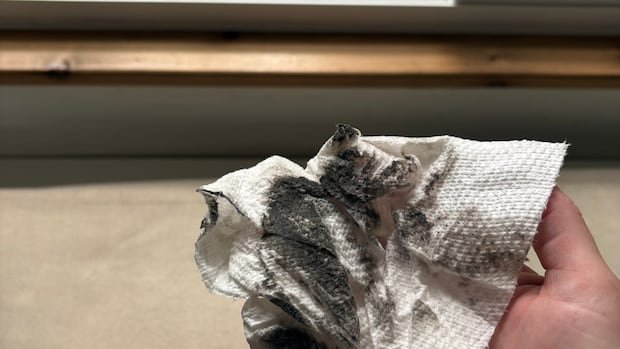

A group of scientists based in Hamilton has provided insights into the issue of soot accumulation in neighborhoods near the city’s industrial zone. Residents have long voiced concerns about a dirty, black residue covering their properties, with a recent spike in complaints in early July. Sarah Styler, an environmental chemistry associate professor at McMaster University, and Grace Yao, a PhD candidate under Styler’s supervision, are part of a study named “What’s the Grime?” aimed at addressing this matter.
Through collaborative efforts with volunteers who gathered samples across the city in 2024 and 2025, the researchers discovered that the soot contains hazardous substances consistent with coal burning. They identified elevated levels of dust and polycyclic aromatic hydrocarbons (PAHs) near the industrial district in northeast Hamilton. Styler collaborated with Environment Hamilton on this research, supported by a $15,000 grant from the university.
Styler, residing in east Hamilton, and Yao, based in Corktown, have firsthand experience with the soot issue. The researchers found historical references to the soot dating back to the 1950s during their investigation. By using sampling kits distributed to 50 volunteers’ homes throughout the city, they collected and analyzed soot samples at four-month intervals.
Styler emphasized that more dust falls closer to the industrial sector, with higher concentrations of toxic compounds nearer to the industrial zone. The team observed higher PAH levels in the winter compared to summer. While the study focused on 13 different PAHs, Styler noted that other toxic substances could also be present in the grime.
The researchers couldn’t examine all components of the grime due to resource constraints, leaving room for potential contributions from other sources besides coal combustion. Although their research didn’t pinpoint industrial-specific sources of PAHs, Styler suggested that ongoing monitoring and enhanced analytical capabilities could provide more insights.
According to Styler, the study results are likely unsurprising to residents experiencing the fallout, as the industrial emissions’ impact seems evident. Despite the community’s frustration over the lack of official information, the Ministry of the Environment, Conservation and Parks is conducting necessary tests to identify potential sources of the soot.
Styler stressed that their findings contradict claims that the soot primarily consists of road dust and reaffirmed that it is predominantly an industrial byproduct. The team plans to share more findings after peer review, expand the volunteer pool, investigate additional compounds in the grime, and explore effective cleaning methods. They are scheduled to present their results at a community meeting on August 20.