
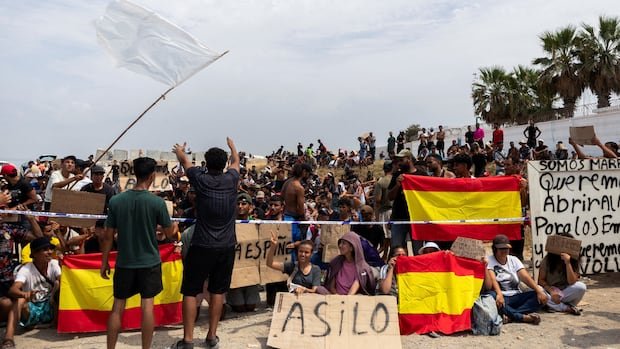

Hundreds of migrants who recently arrived in Ceuta, Spain’s North African enclave, gathered for a demonstration on a popular urban beach on Sunday, calling on Spanish authorities to provide them with asylum instead of returning them to Morocco. They were part of the 5,000 to 8,000 individuals who remained in Ceuta following the mass border crossing two weeks ago, which witnessed over 72,000 people entering the small territory with an approximate population of 80,000. The majority of the migrants voluntarily returned in the days that followed.
Facing strained resources in the city, most migrants were residing in challenging conditions on El Trampolin beach or the outskirts of the city, awaiting an opportunity to travel to mainland Europe. Ayoub Elarroud from Tetouan, Morocco, expressed the difficulties they were enduring, highlighting issues such as sleeping near the sea in cold and unsanitary conditions, with police preventing them from accessing the city center.
During the protest, migrants displayed Spanish flags and banners with messages like “We don’t want to go back to Morocco” and “We are also human,” while voicing chants such as “We’re tired” and “We need a solution.” Some migrants were seen washing clothes or fishing with makeshift bamboo rods on the rocky shores behind them.
Interior Minister Fernando Grande-Marlaska recently stated that irregularly arrived migrants would not be permitted to stay in Ceuta, travel to mainland Spain, or obtain legal status, except in rare cases of extreme vulnerability. Ceuta’s head of the medical board, Enrique Roviralta, expressed concerns about the overwhelmed health-care workers in the city and criticized the slow response from the central government. He noted the emergence of diseases like infectious diarrhea and scabies, along with an increase in violence-related injuries.
Health Minister Monica Garcia refuted claims of a collapsed health service but acknowledged the pressure it was under. She denounced linking migration to illness as unjust and xenophobic, pointing out a moderate risk of epidemic outbreaks for migrants and a low risk for residents.
Many Moroccan migrants cited poor working conditions as the driving force behind their decision to migrate, despite having higher qualifications. One migrant, Mohammed Ouanzar, highlighted the financial challenges in Morocco, where meager salaries hindered basic life goals like homeownership and starting a family. Another migrant, Emmanuel, who fled conflict in northeastern Nigeria, embarked on a dangerous journey through multiple countries to provide a better future for his children.
The migrants’ stories reflect a mix of economic hardships, aspirations for a better life, and challenges faced on their journeys to Ceuta, showcasing the complexities and struggles they endure in pursuit of safety and opportunities.