
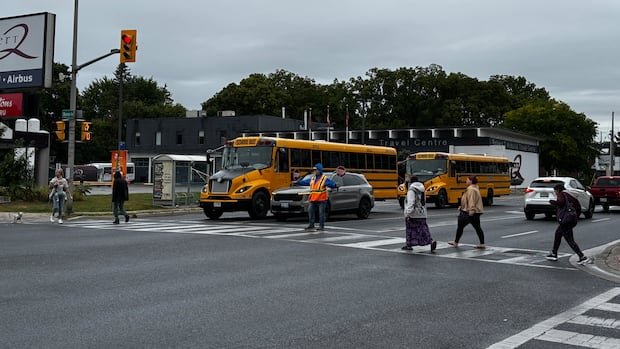

London is urged to reconsider its approach to assigning school crossing guards, as per a city staff report set for committee review on Wednesday. The report suggests a thorough evaluation of the criteria used to determine the need for crossing guards at intersections, marking the first reassessment since 2013. The infrastructure and corporate services committee (ICSC) will deliberate on the proposal before presenting it to the full council.
This review follows a directive from the city council last summer for staff to enhance the school crossing guard program. Many parents feel this review is long overdue, including Sarah Meyer, a resident of the Huron Heights neighborhood with four children.
Meyer, whose eldest child attends Evelyn Harrison Public School, expressed concerns about the safety of children walking to school due to the lack of supervision at certain intersections. She emphasized witnessing risky behaviors by both children and drivers, underscoring the need for more crossing guards at key intersections to ensure everyone’s safety.
Currently, London employs 106 crossing guards across 104 locations, funded through property taxes at an annual cost of $1.6 million, fully allocated within the budget. The process for requesting new crossing guards involves an assessment by city staff based on criteria established by the Ontario Traffic Council (OTC) and further developed by the municipality.
ICSC committee member and Ward 4 Coun. Susan Stevenson criticized the outdated criteria for evaluating the need for crossing guards, stressing the importance of updating metrics to reflect the city’s growth and changes over the years. The staff report recommends a review of the warrant criteria process and collection of fresh data on existing crossing guard locations in London.
If approved by the ICSC committee and subsequently by the full council, city staff will be tasked with reporting back on their findings and recommendations. Stevenson emphasized the need for an expedited process and a clear timeline for implementation to address the longstanding concerns raised by the community.
In a broader context, a survey conducted by city staff with over 100 school principals highlighted both positive views on the school crossing guard program and areas for improvement, including the need for a more streamlined process to report safety concerns. Principals also expressed general safety worries around schools, citing increased traffic and unsafe driver behaviors, indicating a broader need for traffic enforcement near school zones.
Linda Steel, vice chair of the London Catholic District School Board, emphasized the critical role of crossing guards in ensuring student safety amid growing concerns about traffic congestion and driver behavior around schools. Meyer echoed the sentiment, calling for increased vigilance from drivers alongside the need for more crossing guards in her neighborhood to enhance overall safety.