
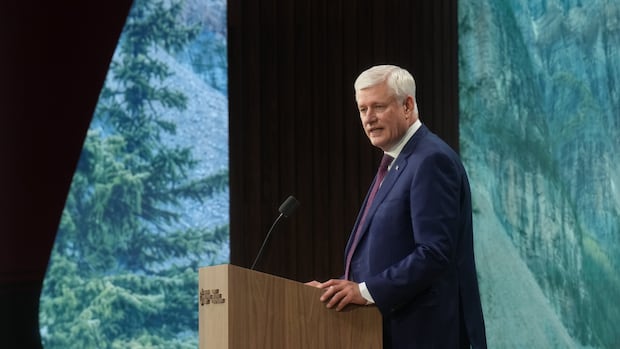

Stephen Harper, the former prime minister who guided Canada’s Conservative Party for more than ten years, expressed support for the federal government’s choice to abandon trade negotiations with the United States “to witness a trade conflict begin in earnest.”
Harper made these remarks during the final keynote address at the inaugural Canada Investment Summit, attended by hundreds of the globe’s wealthiest investors in downtown Toronto.
“This must have been an incredibly tough decision, but I truly believe that our government had no alternative but to take this route,” Harper stated.
Identifying himself as “probably the most pro-American prime minister in Canadian history,” Harper acknowledged his longstanding respect for the United States.
However, he insisted that Canada must remain dedicated to preserving its economic diversity, cautioning against allowing U.S. President Donald Trump’s administration to “weaken” the nation’s industrial capabilities.
“It is evident that the present U.S. administration sees our level of economic integration as incompatible with our independent sovereignty,” Harper remarked. “Hence, to uphold that sovereignty, we must strive to reduce our dependence on the United States.”
“I find this situation very unfortunate, yet equally necessary,” he added.
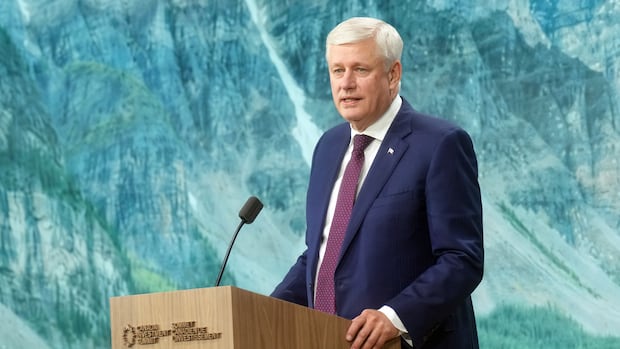
At Prime Minister Mark Carney’s Canada Investment Summit in Toronto, former Conservative Prime Minister Stephen Harper stated that he believes the Carney administration ‘had no choice’ but to exit trade negotiations with the United States and that Canada ‘must pursue reduced dependence’ on its southern neighbor.
In light of Canada’s shift away from its former relationship with the U.S., Harper suggested that the nation is uncovering an opportunity to realize its full potential.
“Leadership is characterized by taking responsibility for what you can manage,” he emphasized, noting that Canada cannot solely attribute its challenges to external influences.
Harper contended that Canada must become “more internally competitive, more connected externally, and more genuinely sovereign than it has been.”
His comments marked the conclusion of the multi-day investment summit led by Prime Minister Mark Carney.
The summit gathered numerous business executives, foreign investors, and current and former politicians, aiming to secure $1 trillion in investments over the next five years to finance significant projects across Canada.
-
Stephen Harper states Canada must urgently lessen its dependence on the U.S.
-
Harper urges Liberals and Conservatives to unite against Trump and separatist threats
Harper participated in the summit as the chair of the Alberta Investment Management Corporation (AIMCo), a role he has occupied since 2024.
The ex-prime minister indicated to the assembly of investors that Canada’s resource development represents its “competitive edge,” asserting that achieving energy superpower status is “essential for our prosperity and indeed for our survival as a nation.”
‘I wish I had conceived of it,’ Harper remarks about the summit
Harper criticized the Liberal government that succeeded him after his 2015 electoral defeat, claiming that until that time, “Canada was on the verge of becoming that energy superpower.”
He stated that Canada lost that opportunity “due to deliberate policy decisions made in the following decade.”
“However, there is no point in lamenting what has transpired,” Harper continued. “Especially since the chance to become that global energy superpower is fortuitously presenting itself to us once again.”
Harper commended Carney’s Liberal government for its initiatives to expedite major project approvals, particularly regarding Alberta’s oilsands. He also praised Ottawa for organizing the investment summit.
“It is such an exceptional innovation that I wish I had thought of it,” Harper shared with a laughing audience.
Despite the praise, Harper made it clear: “More needs to be accomplished.”
He urged the removal of barriers and restrictions in Canada “that are absent elsewhere,” and called for the government to reform its regulatory reviews and permitting processes to provide investors with a level of certainty “as we had established a decade ago.”
-
Carney government unveils mega-deduction tax initiative to stimulate further investment
-
Canada’s four largest airports to be opened to private investment, Carney announces
Harper cautioned that if the government does not eliminate these obstacles, the U.S. will remain Canada’s sole customer, and “they will not lack the urgency that we have failed to show here in Canada.”
“That is why I must express that I am very encouraged by the comprehensive comments the prime minister made today regarding addressing these issues, and I welcome them,” Harper stated.
“I believe that Canada’s new government is dedicated to further reforms in these areas and is committed to their urgency.”
Harper’s shift in perspective
Harper’s endorsement of the summit and elements of the current government’s strategies is particularly significant given that the former Conservative prime minister has not always shown such solidarity with Carney.
Just last year, Harper accused Carney of exaggerating his role as the Bank of Canada governor during the 2008 financial crisis, which was managed by Harper’s administration.
“I have listened, with growing disbelief, to Mark Carney’s attempts to take credit for actions he had little or nothing to do with back then,” Harper stated in a fundraising letter at that time.
Carney served as the Bank of Canada governor from 2008 to 2013, under Finance Minister Jim Flaherty. Carney’s campaign website claims he “guided Canada through one of the most turbulent economic periods in modern history, safeguarding jobs and ensuring that Canada emerged stronger.”
During the 2025 election, Harper endorsed Conservative Leader Pierre Poilievre “without hesitation, without equivocation, without a shadow of a doubt,” for prime minister over Carney.
However, in the past year, Harper returned to public view, delivering various speeches advocating for Canadian unity and the reduction of the country’s reliance on an increasingly “hostile” American neighbor.
In February, Harper suggested Canada should contemplate imposing tariffs on U.S. goods, warning that a one-sided tariff structure could devastate the manufacturing industry. After trade negotiations stalled in August, Carney’s government implemented countermeasures, including tariffs against the U.S.
Tag: rewrite-pending