
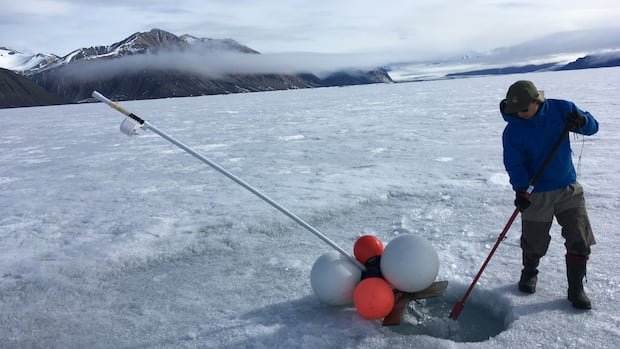

Canada’s sole remaining epishelf lake, characterized by freshwater resting atop saltwater, has vanished, confirming scientists in a recent study. Jérémie Bonneau, an assistant professor at Laval University in Quebec City and the lead author, expressed sadness over the loss of the Milne Fiord epishelf lake on Ellesmere Island in Nunavut, emphasizing its uniqueness as the final such feature in Canada. This disappearance signifies the impact of a warming climate on reshaping the Arctic environment.
Previously reported, the lake’s demise is further detailed in a new study recently published in the journal Scientific Reports, indicating an irreversible loss that marks the end of a 4000-year era. The dramatic disappearance of this once common phenomenon underscores the transformative effects of a warming climate in the Arctic region.
Epishelf lakes form due to glaciers flowing into the sea and any resulting meltwater typically mixing with seawater. However, in the case of the Milne Fiord, the mouth of the fiord had been obstructed for millennia by the Milne Ice Shelf, preventing freshwater from entering the ocean and allowing it to accumulate on top of the Arctic Ocean’s saltwater. This unique setup created a floating freshwater layer due to the lower density of freshwater compared to saltwater.
The lake’s distinctive ecosystem, comprising separate freshwater and saltwater communities in close proximity, showcased a rare phenomenon. The study revealed a diverse array of bacteria, viruses, and phytoplankton thriving in the two layers, with minimal overlap between the communities. The lake’s inhabitants, including bacteria, eukaryotic microbes, and viruses, exhibited unique characteristics not commonly found in Arctic waters.
The collapse of the Milne Ice Shelf in 2020 led to the lake’s demise as the ice wall could no longer contain it. The loss of the lake and its inhabitants was swift, with the freshwater draining into the ocean within two months of the ice shelf breakup, leading to an immediate impact on the lake’s ecosystem. While epishelf lakes have disappeared from Canada, a few still exist in Greenland and Antarctica, though their future is uncertain in the face of ongoing environmental changes.
Researchers emphasized the irreplaceable loss of these ecosystems and the urgent need to address climate change to preserve the planet’s natural wonders for future generations.