
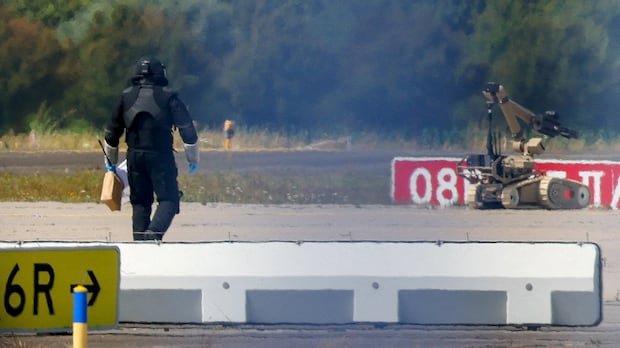

German authorities are currently investigating a drone carrying explosives and a detonator discovered at Leipzig airport. Russian Foreign Minister Sergey Lavrov has indicated Moscow’s intention to escalate retaliation against nations supporting Ukraine. Lavrov mentioned in an interview with VGTRK, Russia’s state media, that they will employ stronger measures to dismantle support for Kyiv’s military efforts, emphasizing ongoing actions in this regard.
The drone, containing an unidentified explosive device, was found in the security area of the cargo operations zone near the south runway at Leipzig airport, which is considered critical infrastructure. The airport plays a pivotal role in NATO operations, facilitating the transport of weaponry, ammunition, and military supplies to Ukraine through flights operated by Ukrainian cargo companies.
This incident, involving the drone positioned next to a Ukrainian cargo plane, has raised significant concerns in Germany. The country’s Interior Minister Alexander Dobrindt described it as a serious threat, emphasizing that it appears to be part of a sophisticated hybrid threat scenario rather than the work of amateurs.
German authorities are actively investigating the origin of the drone, with U.S. intelligence officials suggesting potential links to the Russian government. Berlin is taking a cautious approach, enhancing anti-drone capabilities while refraining from premature attributions until the investigation yields concrete findings.
According to Dobrindt, Russia has been employing various tactics, including drones, espionage, sabotage, and influence operations across Europe, particularly ahead of upcoming regional elections in Germany. Germany has been experiencing continuous hybrid warfare activities aimed at destabilizing the country and influencing political and social changes.
Furthermore, Dobrindt highlighted that Germany faces daily hybrid warfare threats, such as espionage, cyber attacks, and covert actions by foreign entities seeking to disrupt the nation’s stability and security. Recent incidents, including a thwarted assassination plot against a German defense contractor CEO and the arrest of a suspected Russian spy, underscore the ongoing challenges posed by foreign interference.
The Institute for Strategic Dialogue (ISD) has been monitoring Russian interference in Germany through online campaigns like Operation Overload, which aims to exploit internal divisions within NATO member countries and Ukraine. These efforts focus on undermining Ukraine’s military efforts and destabilizing democratic processes, particularly in Germany, France, and Ukraine.
Germany remains vigilant against disinformation campaigns and interference attempts, especially during critical events like regional elections. The country is actively addressing these threats, as highlighted by Dobrindt, who emphasized the need to counter such misinformation activities that target German politics and society.
Hans-Jakob Schindler, from the Counter Extremism Project, characterized the drone incident in Leipzig as an aggressive escalation of Russia’s interference tactics. He raised concerns about the potential consequences of such attacks, emphasizing the need to draw clear boundaries between hybrid warfare activities and conventional military aggression.
Schindler noted a shift in Russia’s approach, with Lavrov’s recent statements indicating a more aggressive stance towards Europe, the West, and NATO. This shift signifies a heightened threat level and underscores the need for robust responses to deter further escalations in hybrid warfare tactics.