
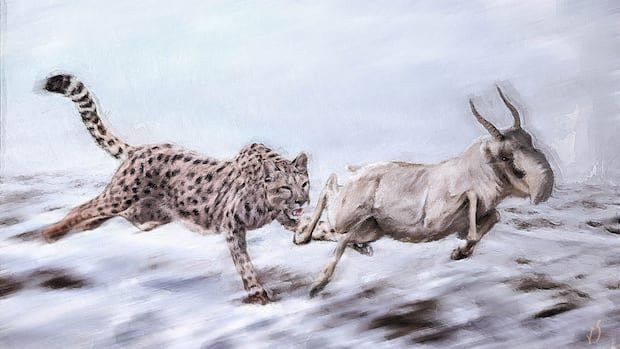

Bones initially thought to belong to an ice-age puma or cougar were discovered in the Bluefish Caves and a mine site in northern Yukon. However, a DNA analysis conducted by the University of California revealed a different story.
The analysis was carried out by Molly Cassatt-Johnstone, a lab technician who had recently completed her undergraduate studies. These Yukon bones were among the first samples she had ever worked on.
Upon conducting the initial analyses, Cassatt-Johnstone realized that the bones did not resemble pumas at all, leading to her disbelief. Yukon paleontologist Grant Zazula vividly recalls the surprising message he received that evening, informing him that the supposed cougars were, in fact, cheetahs.
Zazula reflects on the advancements in ancient DNA analysis, mentioning that 25 years ago, this type of genetic analysis seemed like science fiction but has now become a common practice for studying permafrost-preserved bones from the Yukon.
Cassatt-Johnstone successfully identified a Yukon Miracinonyx, also known as the extinct American cheetah, becoming the primary author of a paper published in Current Biology that delves into the ice-age cat’s diet and habitat.
‘A Fascinating Mystery Unraveled’
Researchers had long believed that the American cheetah, resembling today’s living cheetahs with their long limbs and sleek physique, would have evolved to pursue pronghorns on grassy plains. The discovery of these creatures in the Arctic tundra puzzled paleontologists.
Cassatt-Johnstone explains that the cheetahs were initially thought to be highly specialized predators of American pronghorn antelope in the lower 48 states, where pronghorns were abundant. However, there were no pronghorns in Beringia.
Beringia, the region where Asia and North America were once connected, encompasses present-day Russia’s easternmost area, Alaska, and the Yukon.
To understand how Miracinonyx thrived in this region, researchers, in collaboration with Canadian and U.S. partners, turned to stable isotope analysis. This technique, akin to forensic investigation, examines chemical traces to determine the diet and environmental conditions of ancient species.
Bone samples from the cheetah’s paw and leg were meticulously analyzed using a precise process that Matthew Wooller likens to distinguishing between plain carrots and carrot cake based on isotopic signatures.
Wooller, from the Alaska Stable Isotope Facility at the University of Alaska Fairbanks, expressed his fascination with the unique data obtained from the study, which revealed that Yukon cheetahs predominantly fed on fish, a behavior uncommon among past and present-day felines.
The study’s findings shed light on the cheetahs’ reliance on Yukon salmon, offering a new perspective on their dietary habits and survival strategies. The research also revealed that Miracinonyx shared a closer genetic relationship with North American pumas than African cheetahs, indicating low genetic diversity and potentially limited adaptability.
Yukon Cheetahs and Their Salmon Affinity
These revelations have intrigued paleontologists like Julie Meachen, an expert in Late Pleistocene mammalian carnivores, who noted the significant behavioral differences exhibited by Yukon cheetahs compared to their counterparts in midcontinental North America.
In a region teeming with formidable predators like Beringian lions, scimitar cats, and giant short-faced bears, the relatively small cheetahs likely capitalized on the abundant Yukon salmon runs as a readily available food source.
The study’s comprehensive genetic analysis highlighted the species’ low population numbers and lack of genetic diversity, factors that could have contributed to their eventual extinction.
Zazula proposes renaming this distinct northern population from ‘American Cheetah’ to ‘Yukon Cheetah’ in light of their unique ecological adaptations. The discovery underscores the ongoing surprises hidden within the Yukon’s ancient bones, emphasizing the continuous unraveling of new narratives in paleontological research.
Tag: rewrite-done