
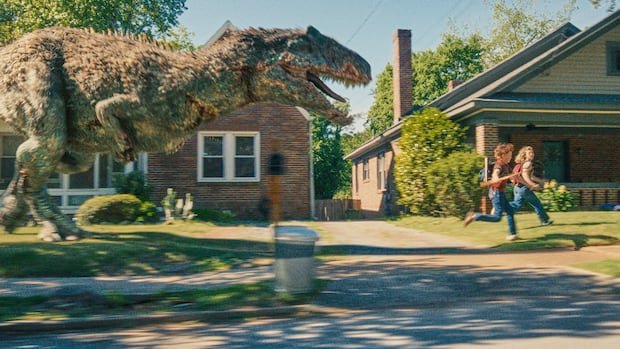

A large serpent-like creature emerges from a nearby pool. Feathered reptiles pursue a family down their driveway. Two massive furry creatures lean against a house and engage in intimate behavior. This is the new movie, “The End of Oak Street,” entering theaters, driven by dinosaurs and a nostalgic affection for “Jurassic Park.”
Despite Hollywood’s prolonged fascination with prehistoric creatures, the dinosaurs in this film notably diverge from past depictions, reflecting a long-awaited update from the perspective of paleontologists. Experts weigh in on the accuracy of the movie’s portrayal of feathers and fauna, highlighting where filmmakers have bridged gaps in the fossil record that still present unanswered fundamental questions.
One burning question remains: Did dinosaurs really engage in such behavior? Paleontologists find the abundance of feathers on the movie’s dinosaurs refreshing, as it diverges from the typical scaly depictions seen in previous films like “Jurassic World.”
Historically, Hollywood’s representation of dinosaurs has lagged behind scientific discoveries linking dinosaurs to birds. Recent fossil findings, starting in the 1990s, have revealed evidence that many non-avian dinosaurs possessed feathers, challenging the traditional scaly image perpetuated by movies like “Jurassic Park.”
“The End of Oak Street” boldly incorporates feathers into its dinosaurs, a departure from typical dinosaur movies. The film’s Allosaurus, resembling a T. rex to some viewers, is depicted with feathers, deemed plausible due to its proximity to the bird evolutionary line. While some creatures in the movie are artistic inventions, they are grounded in scientific plausibility based on their theropod group classification.
The film takes creative liberties with its portrayal of certain animals, such as a giant legless aquatic creature inspired by prehistoric snakes and living amphibians. However, some creatures showcased in the movie are entirely speculative, lacking any fossil evidence to support their existence.
In the realm of sauropods, the film introduces fluffy, furry versions of these dinosaurs, a departure from scientific expectations. The depiction of sauropods mating in the film, resembling dogs, raises eyebrows due to the creatures’ immense size and the mystery surrounding dinosaur mating behaviors.
Unraveling the complexities of dinosaur reproduction remains a challenge for scientists, given the limited fossil evidence and the difficulty in preserving soft tissues. Recent discoveries have shed some light on dinosaur genitalia, but many aspects of dinosaur mating behaviors remain speculative due to the lack of direct observation and incomplete fossil records.
While the specifics of dinosaur mating behavior may remain elusive, “The End of Oak Street” presents a portrayal that, while not definitive, does not stray into the realm of impossibility according to experts. The movie’s depiction of dinosaur sex, while intriguing, falls within the realm of scientific plausibility, offering a fresh perspective on these ancient creatures.