
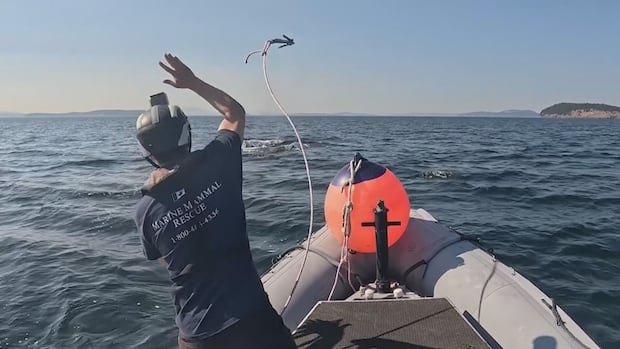

Marine mammal rescuers operating on Vancouver Island have reported a significant increase in whale entanglements this summer. Paul Cottrell, the marine mammal coordinator at Fisheries and Oceans Canada, stated that his team has been responding to an average of one to two entanglements per week over the past two months, consistent with last year’s figures. In addition to responding to entanglements, the team has also been conducting several necropsies.
The most recent incident involved a humpback whale calf and its mother near the south coast of Vancouver Island. The calf was found entangled in over 100 meters of rope, which it had been towing since July 5 when it went missing from B.C.’s central coast. The rescue team, in collaboration with U.S. counterparts, spent seven hours freeing the calf, marking the third activation of their team in less than two weeks.
Cottrell highlighted the growing frequency of entanglements, noting that the number of humpbacks in inshore waters in British Columbia has increased significantly. While this is a positive sign of the “humpback comeback,” it has also led to more interactions with inshore fishing gear, resulting in entanglements.
Jackie Hildering, a researcher and educator at the Marine Education and Research Society (MERS), emphasized the importance of conservation efforts in providing humpback whales with a “second chance” after being hunted to the brink of extinction. However, she expressed concerns about the rising entanglement rates, with 50% of the whales she has studied showing signs of previous entanglements.
Hildering stressed the need for prevention and education to address the entanglement issue effectively, as she believes disentanglements alone are not a long-term solution. She encouraged boaters to participate in a whale-safe boating course developed by MERS, endorsed by the federal government, to help prevent humpback entanglements and reduce whale deaths.