
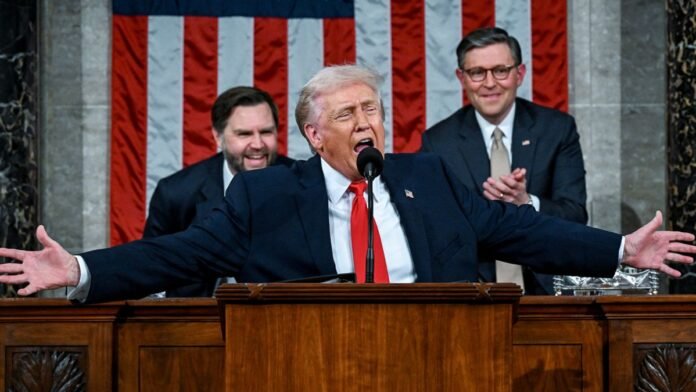

During the State of the Union address, President Donald Trump’s speech resembled a contentious debate rather than a factual overview. Throughout the nearly two-hour presentation to Congress, Trump skewed reality to fit his narrative, with a heavy emphasis on self-praise and a disregard for facts or context relevant to most Americans.
The audience in the divided chamber reflected the stark political polarization, with Republicans enthusiastically applauding Trump’s statements while Democrats appeared stunned and unsure how to react. The address felt more like a rehearsed performance of Trump’s familiar rhetoric, complete with exaggerated theatrics and emotional manipulation.
Trump’s speech featured a series of grandiose claims about America’s prosperity and security, painting a picture of unparalleled success that contradicted many economic and social realities. Despite the confident delivery of falsehoods, the disconnect between Trump’s narrative and actual conditions was glaring.
The President’s speech also touched on divisive issues such as racism, immigration fear-mongering, and unsubstantiated claims of voter fraud, setting the stage for controversial policy directions. The event was marked by a lack of genuine engagement, resembling a loyalty ceremony rather than a democratic tradition.
Critics noted Trump’s disregard for checks and balances, as he openly challenged judicial oversight while his supporters cheered on, highlighting a troubling erosion of democratic principles. The address, though lengthy and broadcast extensively, failed to inspire or persuade, reinforcing existing public skepticism toward Trump’s policies and leadership.
In conclusion, Trump’s State of the Union address underscored a presidency mired in outdated grievances and falsehoods, failing to offer a vision for national renewal. The spectacle revealed a leader out of touch with reality, leading to further public disillusionment and skepticism about the administration’s direction.