
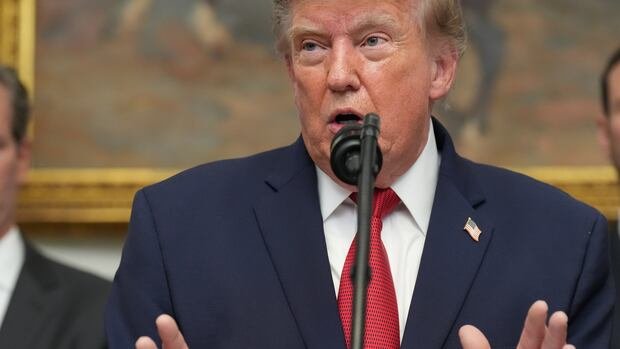

U.S. President Donald Trump declared on social media Wednesday his intention to initiate what he labeled as “the MOST CRUSHING ECONOMIC OPERATION EVER TAKEN AGAINST ANY COUNTRY!” Trump emphasized that this would involve Economic Warfare and Isolation on an unprecedented level, although he provided minimal specifics.
In his post on Truth Social, Trump also cautioned of economic repercussions for any nation that backed Tehran or extended any form of support to Iran. He stated, “ANY country that allows its financial institutions, businesses, airports, or government entities to provide any type of lifeline to Iran will itself face TREMENDOUS Economic Consequences.” Trump did not identify the specific actions Washington would pursue against such countries, nor did he mention any country by name, emphasizing the need to halt activities such as oil smuggling, swap lines, cash transfers, exchange houses, ship registries, and front companies immediately.
The ongoing conflict in the Middle East has resulted in significant casualties over the past six months, with multiple Gulf nations becoming involved. Iran’s ability to disrupt shipping through the Strait of Hormuz, a crucial passage for global oil transportation, has rattled international markets. Previous ceasefire agreements between the U.S. and Iran aimed at restoring shipping operations through Hormuz have failed, despite efforts to de-escalate the conflict following Israel’s partial withdrawal from the conflict.
Trump’s statements on social media, although forceful, do not always materialize into concrete actions. The United Arab Emirates recently announced a suspension of trade activities with Iran following claims of missile launches from Iran, which Iran dismissed as unfounded. Amidst these tensions, China’s significant reliance on Iranian oil poses challenges for the U.S. in escalating economic hostilities, considering China’s status as a key U.S. trading partner.
While Trump denied ongoing talks with Iran, Mohammad Mokhber, an adviser to Iran’s supreme leader, expressed Iran’s willingness to engage in dialogue without compromising its principles. Mokhber emphasized that military pressure and sanctions would not weaken Iran’s resolve. This contrasts with previous statements by Jared Kushner, Trump’s son-in-law and special envoy, who portrayed the negotiation process with Iran in a positive light, suggesting that talks were active and potentially more robust than before.