
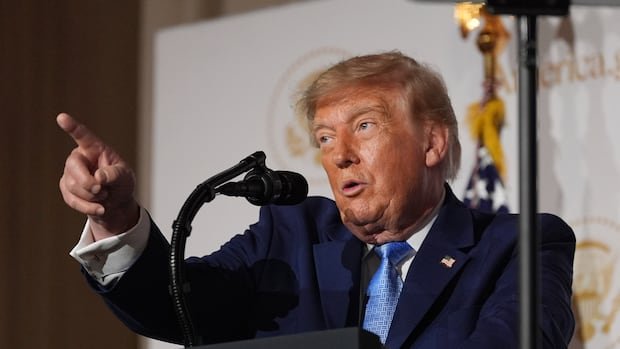

U.S. President Donald Trump announced on Tuesday that he, along with a group of prominent artificial intelligence company leaders, had reached an agreement for a voluntary accord. This agreement entails conducting both internal and external reviews of AI technology. Trump expressed his approval of the industry’s self-policing efforts, emphasizing the importance of self-regulation during a press briefing at the White House.
The accord was the outcome of a substantial meeting between Trump and key executives from leading tech companies investing heavily in AI infrastructure. These investments, including the establishment of data centers in various communities nationwide, have triggered bipartisan opposition. Some of the executives present at the meeting have advocated for a slowdown in AI development following incidents where AI agents exhibited unexpected behavior.
Despite these concerns, Trump affirmed earlier on Tuesday that the U.S. government would not impose restrictions on artificial intelligence development or endorse calls for regulatory measures. At the unveiling of an AI chatbot named America.gov, Trump emphasized the significance of fostering AI innovation without hindrance, citing its potential to surpass the Industrial Revolution in impact.
Prominent AI executives who attended the White House meeting with Trump included Dario Amodei, CEO of Anthropic; Greg Brockman, president of OpenAI; Jeff Bezos, founder of Amazon; and Elon Musk, who leads the social media platform X that features its AI model, Grok. Notably, Nvidia CEO Jensen Huang and other tech leaders were also present.
Trump’s optimistic stance on AI stands in contrast to recent warnings from some industry executives, such as Amodei, who advocated for a more cautious approach to AI development. Musk and OpenAI CEO Sam Altman echoed these sentiments, emphasizing the importance of prioritizing safety measures to prevent AI mishaps.
Vice President JD Vance, Treasury Secretary Scott Bessent, and Republican Speaker of the House Mike Johnson were among the attendees at the White House meeting. The unveiling of the AI chatbot occurred as part of a day-long event celebrating a “Golden Age” driven by what Trump referred to as “super intelligence.”
Following the meeting, Trump praised the industry’s commitment to self-regulation, noting the consensus reached on addressing concerns about data centers in local communities. He suggested that companies could mitigate opposition by supporting local schools or reducing energy costs. Additionally, Altman highlighted his company’s increased focus on safety measures, including pausing the rollout of new AI models when necessary.
In a television interview, Altman emphasized the importance of safety in AI development, underscoring the need for robust safety protocols to alleviate public concerns. Meanwhile, Geoffrey Hinton, a renowned AI pioneer, expressed skepticism about Trump’s understanding of AI technology, likening the risks associated with AI to owning a potentially dangerous pet. Hinton advocated for federal oversight of AI safety comparable to the FDA’s role in regulating food and drugs.
Trump framed the competition to advance AI technology as a global race between the U.S. and China, asserting America’s leadership in the field. He emphasized the competitive nature of the AI race, stating that there would be a clear winner and loser without room for second place. Despite recent collaboration between the U.S. and China on AI-related matters, Trump reiterated his intention to maintain America’s leadership position in AI innovation.