
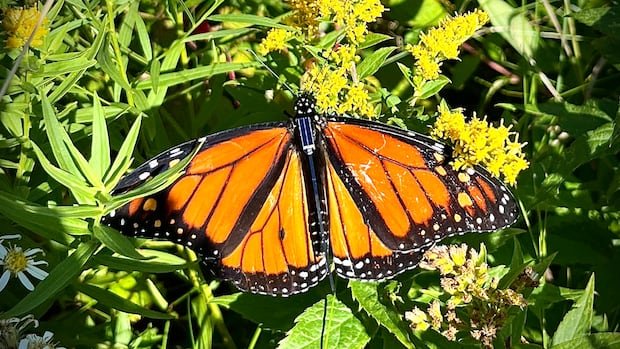

For years, monitoring monarch butterflies with tags relied on chance, hoping someone along their migration route would spot and report the tiny sticker attached to their wings. This year, Nature NB is revolutionizing the process with innovative technology that eliminates the uncertainty.
In a groundbreaking initiative in New Brunswick, Nature NB, in collaboration with the Saint John Naturalist Club, Point Lepreau Bird Observatory, and Environment and Climate Change Canada, has introduced Bluetooth-enabled tags on monarchs for the first time. Francie Morgan, program coordinator at Nature NB, described this as a significant advancement in monarch conservation efforts in the Maritimes.
The newly deployed BluMorpho tags are solar-powered and weigh a mere 0.066 grams, a fraction of the monarch’s body weight. These tags are affixed to the butterfly’s thorax using a small amount of eyelash glue, featuring a tiny antenna along the abdomen for communication.
Unlike traditional wing tags that require physical recapture for data collection, the BluMorpho tags operate through passive Bluetooth interactions. Individuals with Bluetooth activated on their smartphones within 100 meters of a tagged monarch will automatically record a data point.
To track these tagged monarchs, users can download the Project Monarch app and follow their journey. Jim Wilson, a seasoned birder and naturalist at the Point Lepreau Bird Observatory, emphasized the significance of this technological shift from the outdated method of relying on visual sightings to the new online tracking system.
The use of Bluetooth technology on monarchs started last year in Canada through a collaboration between Environment and Climate Change Canada and Birds Canada in southern Ontario. Nature NB secured funding following a successful pilot program and received additional tags from the federal government. Although faced with delays at the border, Nature NB aims to deploy a total of 22 tags this season, potentially increasing to 35 if the remaining shipment clears customs in time.
Early data from the tagged monarchs has already shed light on their migration routes in New Brunswick. The tags have confirmed Point Lepreau as a crucial stopover point for monarchs before they continue their journey towards Grand Manan along the Eastern Seaboard.
Unexpectedly, due to strong westerly winds this season, three tagged monarchs veered off course and ended up in Nova Scotia instead of heading south. This anomaly provides researchers with valuable insights into how wind patterns influence migration decisions.
Tracking individual migration paths could help identify key natural corridors that monarchs rely on most, such as mountain ranges, river valleys, and coastlines, aiding conservation efforts to protect these vital areas.
By downloading the Project Monarch app, anyone can monitor the tagged monarchs, with tags in New Brunswick starting with the prefix PLBO for Point Lepreau Bird Observatory. Nature NB anticipates tagging a total of 22 monarchs in the province by the end of the season.