


On Wednesday, the Federal Communications Commission (FCC) announced its approval for Elon Musk’s SpaceX to launch a network of one million satellites designed for data processing centers in space.
Earlier this year, SpaceX requested permission to establish up to one million orbital computing units to handle vast quantities of data intended for Earth. The FCC confirmed its endorsement of the SpaceX “Starmind” satellite constellation, aimed at addressing the surging demand for artificial intelligence (AI) computing capabilities.
According to the FCC, SpaceX is required to initiate the deployment by November 2033, with an obligation to launch 10 percent of the total, equating to 100,000 satellites, by November 2035, and to achieve 50 percent deployment by November 2038.
The FCC emphasized that granting this application will allow SpaceX to lead the way in innovative technology that bolsters America’s standing in both space exploration and artificial intelligence.
Data centers serve as the essential infrastructure supporting artificial intelligence, demanding substantial energy resources.

“By using nearly constant solar energy with minimal operational and maintenance expenses, these satellites will provide transformative cost and energy efficiency while greatly minimizing the environmental impact linked with traditional data centers,” SpaceX communicated to the FCC.
It remains uncertain if SpaceX will actually deploy one million satellites, considering there are currently 17,000 satellites in orbit. Satellite operators often seek authorization for more satellites than they plan to launch to maintain design flexibility.
-
Under attack: How humanity is losing the night sky
-
SpaceX wants to launch a million satellites. Here’s how that could impact the atmosphere and the night sky
Before initiating the deployment of its Starlink system, SpaceX sought permission for 42,000 satellites. The expanding network currently operates over 11,000 satellites in orbit.
SpaceX’s proposal relies significantly on the anticipated decrease in costs associated with Starship, the next-generation reusable rocket that the company is in the process of developing, to facilitate satellite deployment.
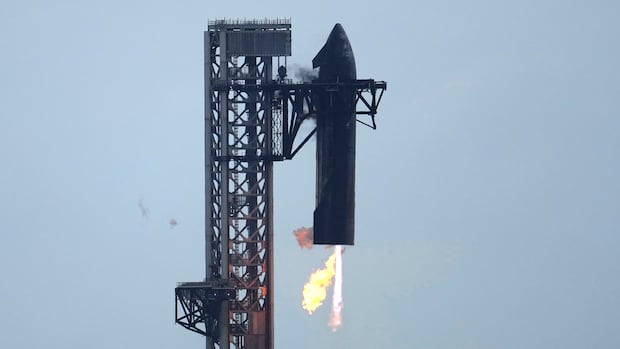
Crowds cheered as SpaceX’s Starship spacecraft returned on Saturday from its longest flight in orbit yet to the tower it was launched from in Texas a day prior. The flight demonstrated the first key recovery of the rocket system’s centerpiece vessel in the company’s decade-long effort to develop a fully reusable rocket.
Amazon’s competing satellite division, Leo, and others have voiced opposition to the proposal, arguing that SpaceX is unlikely to deploy all the satellites and that it might take centuries to achieve this goal. FCC Chairman Brendan Carr dismissed those concerns in March.
“Amazon should concentrate on organizing its own launches and satellite network instead of worrying about others who are actively deploying satellites as quickly and efficiently as SpaceX,” said Carr.
The FCC also indicated it has approved SpaceX’s requests for enhancing its optical network by allowing additional communication capabilities.