
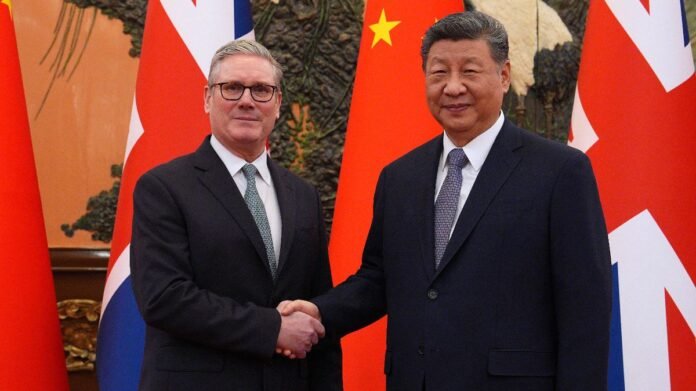

China has decided to remove the ban on UK Members of Parliament (MPs) and peers from visiting the country, as revealed by Keir Starmer. Notably, several prominent figures, including former Conservative leader Sir Iain Duncan Smith, were subjected to sanctions by the Chinese government in 2021. The Prime Minister confirmed the lifting of restrictions following significant discussions with President Xi Jinping.
During a press briefing in Shanghai, Mr. Starmer expressed relief over the resolution of this issue, emphasizing the importance of dialogue. He highlighted that the Chinese authorities have explicitly stated that the restrictions are no longer in effect, allowing all parliamentarians to travel to China freely.
Mr. Starmer attributed President Xi’s decision to engage in constructive dialogue as a validation of his efforts to foster better relations with China. The sanctions imposed by China in 2021 targeted nine UK citizens, including MPs and peers, for allegedly spreading misinformation about the country. Notable individuals affected included Tory MPs Sir Iain Duncan Smith, Nusrat Ghani, Tom Tugendhat, Neil O’Brien, former MP Tim Loughton, as well as Labour peer Baroness Kennedy and crossbench peer Lord Alton.
Furthermore, lawyer Sir Geoffrey Nice QC and Newcastle University academic Jo Smith Finley were also among those sanctioned. The status of sanctions concerning the academics and former MP Mr. Loughton remains unclear, as Mr. Starmer’s confirmation only pertained to parliamentarians.
Prior to the official announcement of the sanctions being lifted, the affected politicians had cautioned against using their status as a bargaining tool. In a joint statement, they underscored their commitment to justice for the Uyghur people and rejected any deal that prioritizes personal convenience over holding accountable those involved in human rights violations. They stood in solidarity with others still facing sanctions by the Chinese government.
The lifting of sanctions comes after a period of heightened tensions between the UK and China over human rights issues, particularly concerning the treatment of Uighur Muslims in Xinjiang. Prime Minister Boris Johnson had previously condemned the human rights abuses and expressed support for those raising awareness of the situation.
Overall, the resolution of this diplomatic conflict underscores the significance of dialogue and engagement in international relations, signaling a potential step towards improved bilateral relations between the UK and China.