
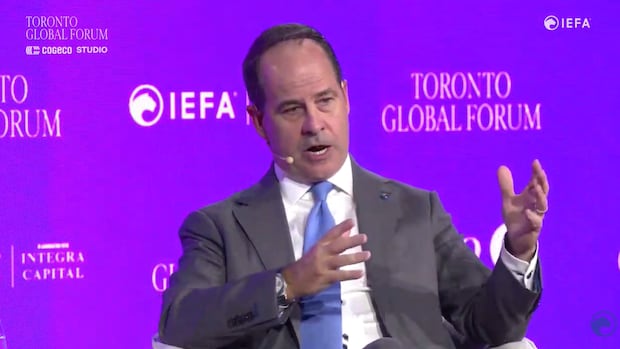

Darryl White, the CEO of Bank of Montreal, has voiced his concerns regarding the trustworthiness of artificial intelligence agents when it comes to handling personal banking details.
During his address at the Toronto Global Forum on Wednesday, White raised alarms about the pace at which AI is evolving faster than the regulations and protections being established for this technology. His statements came in response to RBC’s CEO, who mentioned on Tuesday the possibility of preventing Meta’s widely-used Muse AI agent from accessing customer data at his financial institution.
“We’ve spent the last 25 years adapting to an e-commerce environment that has made us comfortable,” stated White, who leads Canada’s fourth-largest bank by total assets.
He noted that this has led some individuals to feel too at ease about “entering all my personal information anywhere, into any agent.”
“Avoid sharing your banking username and password. Do not disclose your credit card details. Protect your social insurance number. Keep your PIN private. These pieces of information are not secure,” White emphasized.
“I believe we still have significant work to do in educating the public.”
Canada’s major banking institutions have poured billions into artificial intelligence in recent times. White noted in August that BMO’s insurance sector now employs AI to make underwriting decisions in as little as 10 seconds, a remarkable reduction from the former industry standard of 28 days.

If you’ve been looking to buy a home in Ontario, you may have seen a few listings where the furniture doesn’t look quite right. That’s because many of them are being staged virtually, using AI. Experts say there are benefits and drawbacks. CBC’s Talia Ricci breaks down what you need to know.
With the permission of clients, AI agents such as Meta’s Muse and OpenAI’s ChatGPT can access bank accounts and credit cards to track balances and transaction histories, as well as offer advice on spending behaviors. Generally, making purchases necessitates human consent.
On Tuesday, RBC CEO Dave McKay mentioned that his institution is contemplating restricting Muse’s access to client data.
“It’s definitely something I’m considering,” he stated during a television interview with Bloomberg News.
“We’re not rushing into any decisions, but we need to find a balance between consumer needs and the privacy and security of the system.”
Just last week, the CEOs of JPMorgan Chase & Co. and Charles Schwab announced they are either blocking or limiting the access of external AI agents to their clients’ data.