
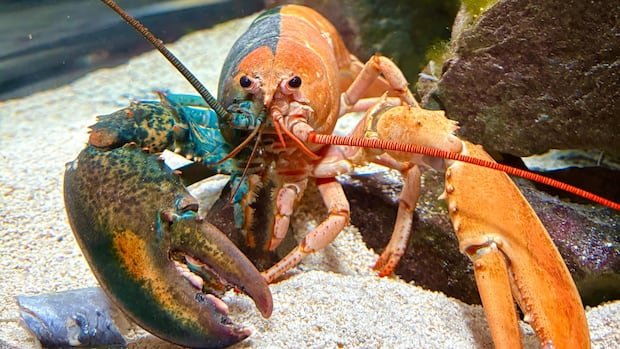

In his four decades as a lobster fisherman, Robert Wagner encountered a unique half-blue, half-orange lobster, split down the middle from head to tail, unlike anything he had ever seen before. Wagner named the lobster Oscar and was amazed by its unusual appearance. This rare lobster was discovered in a trap near Blue Rocks on Nova Scotia’s South Shore.
Wagner decided to share Oscar with others and reached out to Dalhousie University, where the lobster could find a safe haven. Nadia Stewart from Dalhousie’s Beaty Centre for Marine Biodiversity expressed gratitude for the opportunity, emphasizing that lobsters with distinctive colors like Oscar often face threats in the wild due to their visibility.
Stewart explained that Oscar’s unique coloring, a result of a genetic mutation occurring in about one out of every 50 million lobsters, is exceedingly rare. She noted that albino lobsters, found in about one out of 100 million lobsters, are even more uncommon.
After a month of care from Wagner and his family, Oscar was relocated to Halifax with a special transport license. Adjusting well to his new environment, Oscar surprised staff at Dalhousie University by shedding his shell recently. The center decided to display his old blue-orange shell and give him time to recover before returning him to public view once his new shell hardens, which typically takes 14 to 30 days. Oscar’s new shell will also showcase the same blue and orange coloration due to its genetic nature.
Wagner expressed satisfaction with the decision to donate Oscar, stating, “We’re just grateful that it got in the right hands and hope [Oscar] has a good life.”