
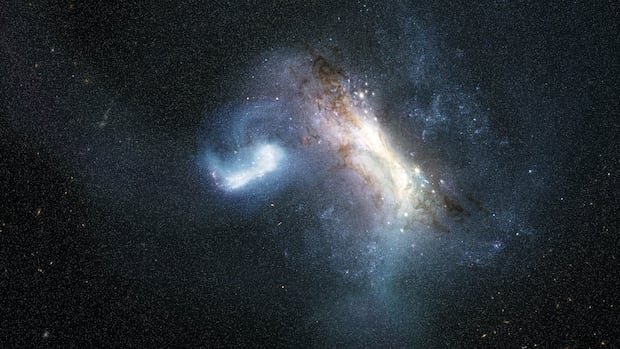

A recent study has shed light on the complex evolutionary journey of the Milky Way, a vast spiral galaxy hosting billions of stars, including our own sun. Researchers have uncovered evidence of a significant event in the Milky Way’s early history, where it absorbed a smaller galaxy approximately 11.8 billion years ago when the universe was much younger.
The merging galaxy, classified as a dwarf galaxy due to its smaller size compared to the Milky Way, was estimated to contain stars equivalent to 500 million solar masses at the time of the merger. This event marked the earliest-known galactic merger for the Milky Way, showcasing how the galaxy expanded not only by internally generating stars but also by assimilating smaller galaxies through gravitational forces.
Utilizing data from the Hubble and Gaia telescopes, scientists studied stellar clusters within the innermost 20,000 light-years of the Milky Way. By analyzing the age, chemical composition, and trajectory of these stars, they traced their origins back to a galactic merger that occurred around two billion years post the Big Bang.
The merging dwarf galaxy, named Low-energy-Kraken-Heracles (LKH), played a crucial role in enriching the early Milky Way with stars, interstellar gas, and dark matter. This discovery challenges previous debates on whether the Milky Way’s growth was primarily fueled by internal star formation or external mergers.
Lead researcher Davide Massari highlighted the peaceful nature of the merger concerning star collisions but emphasized the explosive interaction of gases from both galaxies, likely triggering a burst of star formation. The study underscores the influence of galactic mergers on the Milky Way’s history, with past mergers like Gaia-Sausage-Enceladus and Sagittarius dwarf galaxy shaping the galaxy’s evolution and impacting the formation of our solar system.
Ultimately, understanding the Milky Way’s past mergers contributes to unraveling fundamental questions about our origins and the formation of Earth, according to Massari.