
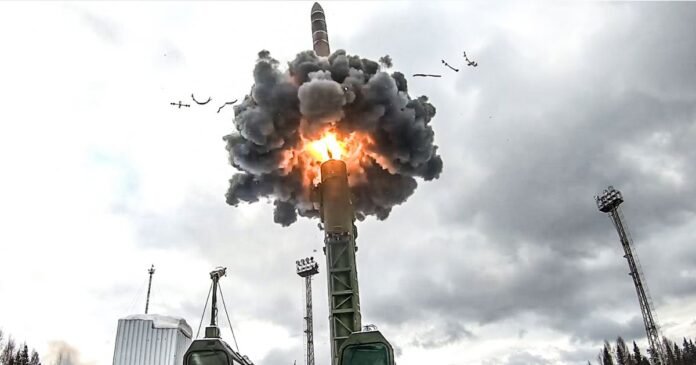

A former CIA operative has pinpointed a European city that may face the detonation of a “non-traditional” nuclear weapon. In a time of rising global tensions due to the ongoing Russo-Ukrainian conflict, escalating China-Taiwan tensions, and the recent capture of Venezuelan president Nicolás Maduro by the US, the year 2026 is perceived as increasingly dangerous.
Andrew Bustamante, a former CIA intelligence officer with experience in the US Air Force and nuclear Intercontinental Ballistic Missile (ICBM) operations, is well-equipped to analyze these tensions. Hosting the EverydaySpy podcast, Andrew maintains a consistent stance on the matter, emphasizing the importance of nations being vigilant and responsive to potential conventional nuclear strikes.
While Andrew deems the likelihood of a nuclear-tipped ICBM in 2026 as highly improbable, he warns of a more concerning possibility – a covert attack that would be harder to predict and counter. He refers to this as a “non-traditional nuclear explosion,” such as a dirty bomb or a smuggled nuclear warhead.
Expressing his views, Andrew dismisses the idea of Russia launching a nuclear-tipped ICBM but highlights the potential threat of a nuclear explosion in a European city like Kyiv, possibly delivered by unconventional means. He stresses the chaos and challenges that would ensue following such an attack, underscoring the importance of an immediate response to prevent further escalation.
Andrew explains that a ‘dirty bomb’ combines conventional explosives with radioactive material, posing a significant threat. He also mentions the Oreshnik, an intermediate-range hypersonic missile capable of carrying multiple warheads simultaneously, recently launched by Russia towards Ukraine.
According to Andrew, quick reactions can lead to escalations, while delayed responses tend to de-escalate conflicts. He believes that it would not be in Russia’s best interest to use nuclear-capable weapons directly, advocating for more covert methods to achieve strategic goals.
In a sobering assessment, Andrew estimates a 25% likelihood of a nuclear device detonation, suggesting that it may not unfold as expected. He speculates on scenarios like a shoulder-launched nuclear missile in the South China Sea to create an electromagnetic pulse (EMP) that could disrupt military operations.
Ultimately, Andrew warns of potential unconventional nuclear threats and the need for swift and strategic responses to safeguard against catastrophic consequences.